What’s Observed on November 8
Born on November 8: Scorpio ♏
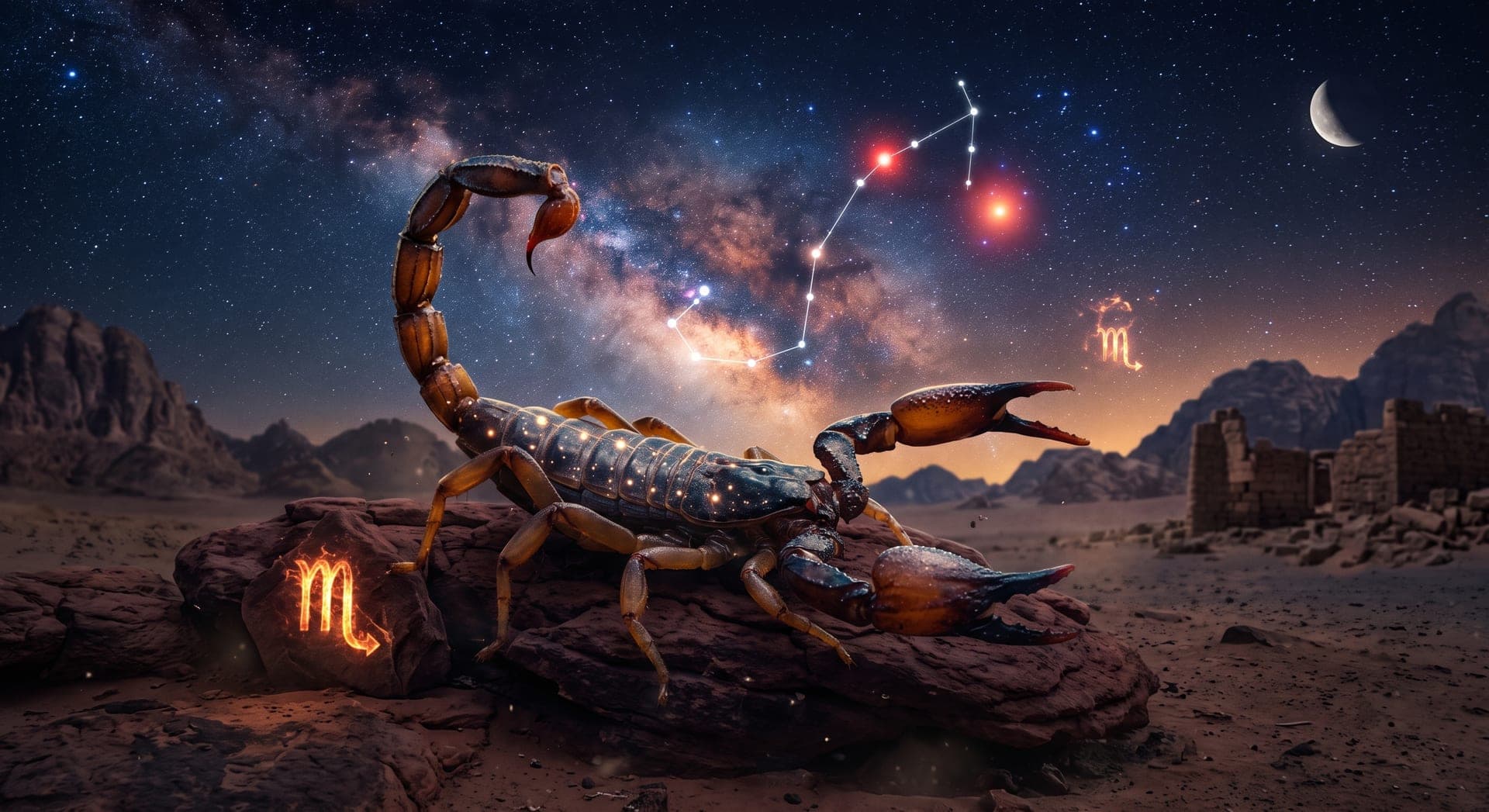
Scorpio, the eighth sign of the zodiac, spans October 23 to November 21 and is symbolized by the scorpion, a creature known for its defensive intensity and the sting it delivers when provoked. Traditionally ruled by Mars and, in modern astrology, by Pluto, the planet of transformation and the underworld, Scorpio carries a reputation as one of the most intense and emotionally powerful signs of the zodiac. As a Water sign, Scorpio experiences the world through deep, often hidden, emotion, guarding its inner life carefully while remaining acutely perceptive of others. Its Fixed modality gives Scorpio remarkable determination and resilience, able to endure hardship and pursue long-term goals with singular focus. People born under this sign are often drawn to work involving psychology, investigation, transformation, or anything requiring the ability to see beneath the surface. Scorpio's loyalty and passion run deep for those it trusts, but that same intensity can curdle into jealousy, suspicion, or an unwillingness to forgive when trust is broken.
Personality Traits
Strengths
- Deeply passionate and determined
- Fiercely loyal to those they trust
- Resourceful and strategic
- Highly perceptive
- Emotionally resilient
Weaknesses
- Prone to jealousy and possessiveness
- Secretive and guarded
- Can be vindictive when wronged
- Distrustful of others
- Prone to obsessiveness
Compatible Signs
Fun Facts
- Scorpio's scorpion symbol connects to the Greek myth of the scorpion sent by Gaia to kill the hunter Orion, with both later placed among the stars.
- Scorpio has two ruling planets: Mars in traditional astrology, and Pluto, discovered in 1930, in the modern system.
- Scorpio is often mistakenly grouped with the Fire signs due to its intensity, but it is actually a Water sign, driven by deep emotion rather than raw aggression.
- Notable Scorpios include Pablo Picasso, Marie Curie, Leonardo DiCaprio, and Hillary Clinton.
- Some astrological traditions associate Scorpio with a secondary, more elevated symbol, the eagle or phoenix, representing transformation and rebirth.
Born on November 8
- 1656
Edmond Halley
English astronomer and mathematician who calculated the orbit of the comet that bears his name and correctly predicted its return in 1758.
- 1847
Bram Stoker
Irish novelist best known as the author of Dracula, one of the most influential works of Gothic horror fiction, written while he lived and worked in London.
- 1866
Herbert Austin, 1st Baron Austin
English engineer and businessman who founded the Austin Motor Company, becoming one of the pioneers of the British car industry.
- 1900
Margaret Mitchell
American author of "Gone with the Wind"
- 1923
Jack Kilby
American engineer and Nobel Prize laureate for the integrated circuit
- 1927
Ken Dodd
English comedian and singer celebrated for his marathon stand-up shows and tongue-twisting patter, one of the last great music hall-style entertainers.
- 1943
Martin Peters
English footballer who scored in the 1966 World Cup final, helping England win its only World Cup title.
- 1954
Kazuo Ishiguro
Japanese-born British novelist awarded the Nobel Prize in Literature, celebrated for works including The Remains of the Day and Never Let Me Go.
- 1956
Richard Curtis
British screenwriter and director behind romantic comedies including Four Weddings and a Funeral, Notting Hill and Love Actually.
- 1966
Gordon Ramsay
British chef, restaurateur and television personality known for his Michelin-starred restaurants and combative cooking competition shows.
- 1989
SZA
American singer-songwriter
On This Day in History
- 1519
Spanish conquistador Hernán Cortés enters Tenochtitlán, where Aztec ruler Moctezuma II receives him ceremonially.
Cortes and his small band of Spanish conquistadors were welcomed into the magnificent Aztec capital of Tenochtitlan by Moctezuma II, who initially treated the Spanish as honored guests despite considerable unease within his court. This peaceful entry proved deceptive, as tensions escalated rapidly in the following months, ultimately leading to violent conflict and the eventual fall of the Aztec Empire.
- 1602
The Bodleian Library at the University of Oxford opens its doors to scholars for the first time.
Founded through the benefaction of Sir Thomas Bodley, a former diplomat who restored and expanded Oxford's earlier university library after it had fallen into disrepair, the library opened with around 2,000 books. It has grown into one of the oldest libraries in Europe and the second-largest in Britain after the British Library, holding the right to receive a copy of every book published in the United Kingdom and Ireland.
- 1605
Robert Catesby, ringleader of the Gunpowder Plot conspirators, is killed resisting capture.
Catesby, considered the principal instigator of the Gunpowder Plot to assassinate King James I, was cornered along with several co-conspirators at Holbeche House after fleeing London following Guy Fawkes' arrest. His death during the standoff with royal forces effectively ended the immediate threat, though several surviving conspirators faced trial and execution in the following weeks.
- 1605
Robert Catesby, the ringleader of the Gunpowder Plot, is killed while resisting capture in Staffordshire.
Catesby had organized the conspiracy to assassinate King James I and blow up Parliament, a plan foiled three days earlier when his associate Guy Fawkes was arrested guarding the gunpowder. Fleeing London with several fellow conspirators, Catesby made a last stand at Holbeche House, where he was shot and killed by the Sheriff of Worcestershire's men, effectively ending the plot's final chapter.
- 1745
Charles Edward Stuart, 'Bonnie Prince Charlie', leads a Jacobite army of around 5,000 troops across the border into England.
Having already raised his standard in Scotland and won a striking victory at Prestonpans, the Young Pretender pushed south in a bid to reclaim the British throne for the exiled House of Stuart. His army advanced as far as Derby before its leaders, faced with a lack of expected English and French support, decided to retreat to Scotland, where the rising was ultimately crushed at Culloden the following spring.
- 1861
The American warship USS San Jacinto stops the British mail packet Trent and seizes two Confederate diplomatic envoys, sparking a diplomatic crisis.
The seizure of envoys James Mason and John Slidell, who were bound for Britain and France to seek support for the Confederacy, outraged the British public and government, which viewed the boarding as a violation of neutral shipping rights. Britain reinforced its forces in Canada and demanded an apology; the crisis eased only after the Lincoln administration released the envoys, narrowly averting a possible war between the United States and Britain.
- 1895
German physicist Wilhelm Röntgen discovers X-rays while experimenting with cathode rays.
Röntgen discovered X-rays somewhat by accident while investigating the properties of cathode ray tubes in his laboratory, noticing that a nearby fluorescent screen glowed even when the tube was covered. His discovery of this new form of electromagnetic radiation revolutionized medical diagnostics almost immediately and earned him the first Nobel Prize in Physics in 1901.
- 1920
Rupert Bear, the illustrated children's comic strip character created by Mary Tourtel, makes his first appearance in print.
Rupert debuted in the Daily Express as the newspaper's answer to rival comic strip characters running in competing publications. The gentle adventures of the white bear in his distinctive red jumper and yellow checked trousers became a fixture of British newspaper comics and children's annuals, and Rupert remains one of the most enduring characters in British children's literature.
- 1923
Adolf Hitler leads the failed Beer Hall Putsch in Munich, an attempt to seize power in Bavaria.
Hitler's attempt to seize power began in a Munich beer hall where he interrupted a political meeting, declaring a national revolution alongside World War I general Erich Ludendorff. The poorly organized putsch collapsed the following day when police fired on the marchers, and Hitler's subsequent trial and imprisonment gave him a national platform that ultimately fueled his later rise to power.
- 1932
Franklin D. Roosevelt is elected the 32nd U.S. President, defeating incumbent Herbert Hoover.
Roosevelt's landslide victory over incumbent Herbert Hoover came amid the depths of the Great Depression, as voters overwhelmingly rejected Hoover's perceived inaction in addressing widespread unemployment and economic collapse. Roosevelt's subsequent New Deal programs would fundamentally reshape the role of the federal government in American economic life for decades to come.
- 1939
German intelligence officers capture two British SIS agents at Venlo on the Dutch-German border in a sting operation.
The agents, Sigismund Payne Best and Richard Henry Stevens, believed they were meeting anti-Nazi conspirators plotting against Hitler, but had instead been lured into an elaborate SS deception. Their capture handed German intelligence detailed knowledge of British secret service operations in Europe and gave the Nazi regime a pretext, cynically invoked, for the invasion of the Netherlands the following year.
- 1957
The United Kingdom conducts its first successful hydrogen bomb test over Kiritimati (Christmas Island) in the Pacific.
The test, part of Britain's Operation Grapple series, confirmed the country's ability to build thermonuclear weapons after earlier attempts had fallen short of full fusion yields. Success made Britain the third nation, after the United States and Soviet Union, to develop a hydrogen bomb, cementing its position as an independent nuclear power during the Cold War.
- 1960
John F. Kennedy is elected the 35th U.S. President, narrowly defeating Vice President Richard Nixon.
Kennedy's narrow victory over Vice President Richard Nixon made him, at 43, the youngest person ever elected president and the first Roman Catholic to hold the office. The closely contested race, decided by a fraction of the popular vote, was later remembered for the televised debates that many credit with reshaping the role of media in American political campaigns.
- 1965
The British Indian Ocean Territory is formally created as a British overseas territory in the Indian Ocean.
Carved out of islands previously administered as part of Mauritius and Seychelles, the territory was established partly to provide a site for a joint UK-US military base on Diego Garcia. Its creation was followed by the forced relocation of the islands' Chagossian inhabitants in subsequent years, an episode that remains a controversial and disputed chapter of British colonial history.
- 1965
The Murder (Abolition of Death Penalty) Act 1965 receives Royal Assent, formally ending capital punishment for murder in the United Kingdom.
The Act suspended the death penalty for an initial five-year trial period, later made permanent, following a sustained campaign by abolitionists highlighting cases of wrongful execution. It marked the culmination of a decades-long debate in Parliament and public life, and Britain's last executions had already taken place two years earlier, in 1964.
- 1972
HBO launches as one of the first American pay television networks.
HBO launched as a subscription-based cable channel, initially available to a small number of households in Pennsylvania, offering commercial-free movies and live sports broadcasts. Its pioneering pay-television model proved enormously influential, eventually inspiring numerous competitors and establishing premium cable programming as a major force in American entertainment.
- 1987
A Provisional IRA bomb explodes during a Remembrance Day ceremony in Enniskillen, Northern Ireland, killing twelve people.
The bombing during a Remembrance Day ceremony at a war memorial in Enniskillen, Northern Ireland, killed twelve civilians and injured dozens more, sparking widespread revulsion even among some IRA supporters. The attack proved a significant turning point in public opinion during the Troubles, prompting increased pressure toward eventual peace negotiations in the region.
- 1987
A Provisional IRA bomb explodes during a Remembrance Day ceremony in Enniskillen, Northern Ireland, killing twelve people.
The device detonated near a war memorial as crowds gathered to honour Britain's war dead, killing eleven civilians instantly and wounding around sixty more; a twelfth victim died years later from his injuries. The attack, one of the most widely condemned atrocities of the Troubles, provoked revulsion on all sides and is often cited as a turning point that damaged public support for the IRA's campaign.
- 2013
Typhoon Haiyan strikes the Philippines, killing more than 6,300 people and causing billions of dollars in damage.
Typhoon Haiyan, one of the most powerful tropical cyclones ever recorded at landfall, devastated the central Philippines with catastrophic winds and storm surges that leveled entire coastal communities. The disaster prompted a massive international humanitarian relief effort and renewed global attention to the growing threat of increasingly intense storms linked to climate change.
- 2016
Donald Trump is elected the 45th President of the United States, defeating Hillary Clinton.
Trump's upset victory over heavily favored Hillary Clinton, secured through the Electoral College despite losing the national popular vote, stunned pollsters and political analysts worldwide. His win represented a significant shift in American political alignment, drawing strong support from voters in traditionally Democratic-leaning industrial states.