What’s Observed on November 28
Born on November 28: Sagittarius ♐
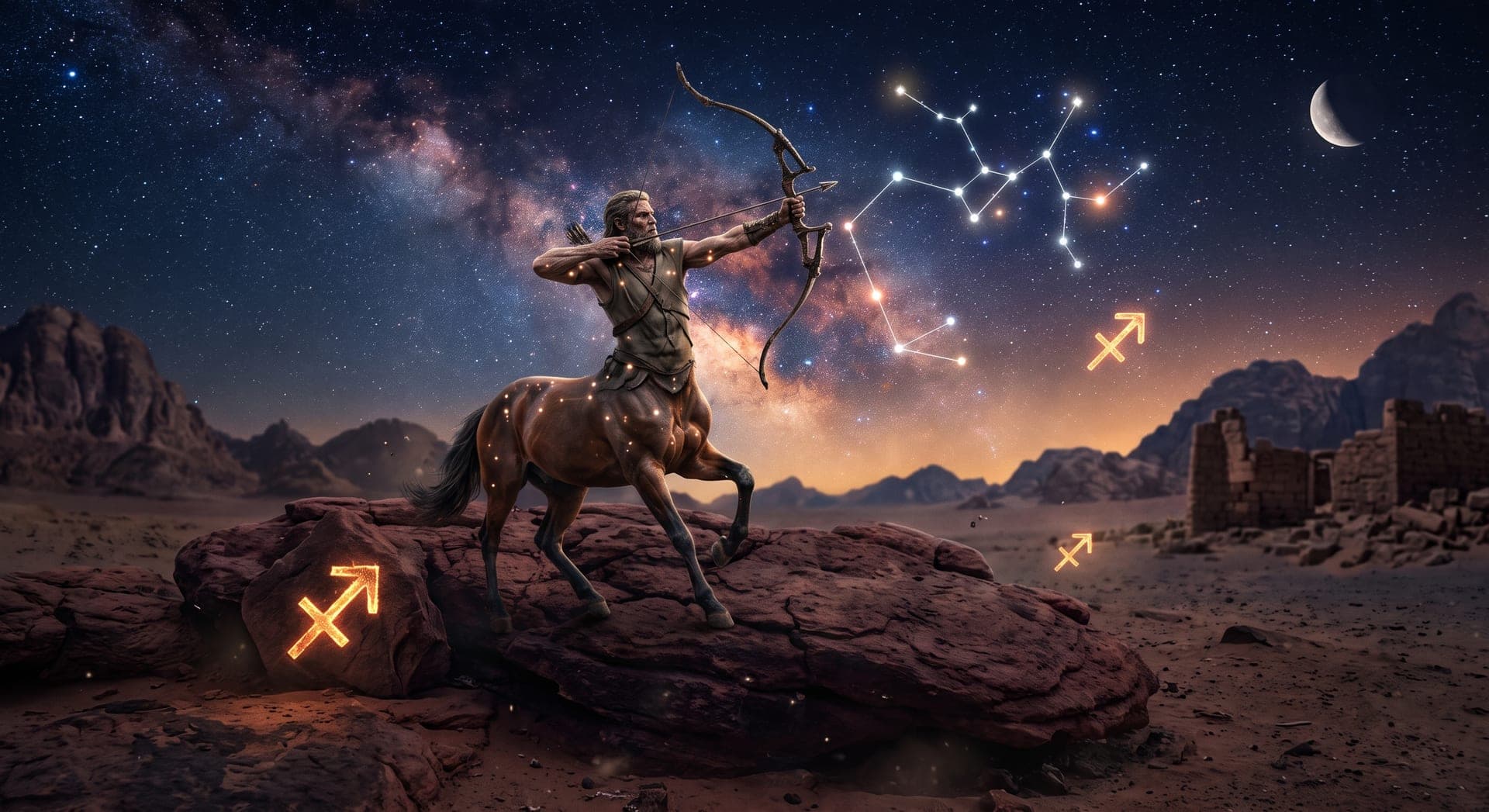
Sagittarius, the ninth sign of the zodiac, spans November 22 to December 21 and is symbolized by the archer, typically depicted as a centaur drawing a bow, representing a restless pursuit of knowledge, adventure, and far-off horizons. Ruled by Jupiter, the largest planet in the solar system and a symbol of growth, luck, and abundance, Sagittarius is widely regarded as one of the most optimistic and freedom-loving signs of the zodiac. As a Fire sign, Sagittarius approaches life with enthusiasm and a genuine hunger for new experiences, whether through literal travel or intellectual and philosophical exploration. Its Mutable modality reflects a deep aversion to routine and confinement, always looking toward the next adventure rather than settling into fixed patterns. People born under this sign are often drawn to travel, higher education, philosophy, or any pursuit that broadens their horizons and understanding of the world. Sagittarius's honesty and optimism make it excellent company, though its blunt directness and restless need for freedom can sometimes come across as tactless or noncommittal to those seeking more stability.
Personality Traits
Strengths
- Adventurous and open to new experiences
- Optimistic and enthusiastic
- Honest and direct
- Philosophical and broad-minded
- Generous and good-humored
Weaknesses
- Tactlessly blunt
- Impatient with routine
- Prone to overpromising
- Restless and commitment-averse
- Careless with details
Compatible Signs
Fun Facts
- Sagittarius's symbol, a centaur drawing a bow and arrow, connects to the Greek myth of Chiron, a wise and scholarly centaur unlike the more unruly members of his kind.
- Jupiter, Sagittarius' ruling planet, is the largest planet in the solar system, reflecting the sign's association with expansion, abundance, and big-picture thinking.
- Sagittarius is one of two zodiac signs, along with Capricorn, represented by a hybrid creature combining human and animal features.
- Notable Sagittarians include Taylor Swift, Walt Disney, Winston Churchill, and Jimi Hendrix.
- Sagittarius season spans the lead-up to the winter solstice, a period historically associated with travel, feasting, and philosophical reflection in many cultures.
Born on November 28
- 1489
Margaret Tudor
Queen of Scotland and elder sister of Henry VIII, whose marriage to James IV in 1503 laid the dynastic foundation for the union of the Scottish and English crowns a century later under her great-grandson James VI and I.
- 1628
John Bunyan
English preacher and writer whose allegorical novel The Pilgrim's Progress, written largely during his imprisonment for unlicensed preaching, became one of the most published and translated works in the English language.
- 1757
William Blake
English poet, painter and printmaker whose visionary works, including 'The Tyger' and the poem later set to music as the hymn 'Jerusalem,' made him one of the most original figures of the Romantic era, though he received little recognition in his own lifetime.
- 1820
Friedrich Engels
German philosopher and co-author of "The Communist Manifesto"
- 1881
Stefan Zweig
Austrian novelist and playwright
- 1929
Berry Gordy
American businessman who founded Motown Records
- 1953
Alistair Darling
British Labour politician who served as Chancellor of the Exchequer from 2007 to 2010, steering the UK economy through the 2008 global financial crisis and the bailout of major British banks.
- 1961
Alfonso Cuaron
Mexican film director
- 1962
Jon Stewart
American comedian and television host
- 1963
Armando Iannucci
Scottish satirist and director best known for creating the political comedy The Thick of It and its film spin-off In the Loop, later adapting the format for HBO's Veep and directing the film The Death of Stalin.
- 1970
Richard Osman
English television presenter and author who co-created and co-hosted the BBC quiz show Pointless before becoming a bestselling novelist with his Thursday Murder Club crime series.
- 1987
Karen Gillan
Scottish actress from Inverness who rose to fame playing companion Amy Pond in Doctor Who before joining the Marvel Cinematic Universe as Nebula in the Guardians of the Galaxy and Avengers films.

On This Day in History
- 1520
Ferdinand Magellan's expedition completes the first passage through the strait bearing his name, entering the Pacific Ocean after 38 days.
After 38 grueling days navigating the treacherous strait later named in his honor, Ferdinand Magellan's fleet finally emerged into open water, which he named the Pacific Ocean for its apparent calm compared to the storms endured in the strait. The passage confirmed the existence of a sea route around South America, though Magellan himself would not survive to complete the full circumnavigation.
- 1582
William Shakespeare and Anne Hathaway pay a £40 bond in Stratford-upon-Avon, allowing them to marry without the usual reading of wedding banns.
The bond, posted by two of Hathaway's neighbours, guaranteed there was no legal impediment to the marriage and let the couple skip the customary three weeks of banns being read in church. Anne was already pregnant with their first child, Susanna, born the following May, making the couple's haste to marry a detail biographers of England's most celebrated playwright have long puzzled over.
- 1660
Twelve scholars, including Christopher Wren and Robert Boyle, meet at Gresham College in London and agree to found what becomes the Royal Society.
The group, which had been gathering informally to discuss experimental science, resolved to establish a permanent society for promoting what they called 'Physico-Mathematicall Experimentall Learning.' Chartered by King Charles II in 1662, the Royal Society became the world's oldest continuously existing scientific institution and a driving force behind Britain's role in the Scientific Revolution.
- 1814
The Times of London becomes the first newspaper printed on a steam-powered press, built by Friedrich Koenig and Andreas Bauer.
The new press could print more than a thousand sheets an hour, several times faster than the hand-operated presses it replaced. Publisher John Walter kept the innovation secret from his own pressmen, who feared it would cost them their jobs, until the finished edition was ready — a turning point that made mass-circulation newspapers commercially viable.
- 1821
Panama declares independence from Spain and joins Gran Colombia, a date now commemorated as Panama's Independence Day.
Panama, along with much of Spanish Central America, declared independence from a weakened Spain and voluntarily joined the newly formed republic of Gran Colombia rather than pursue full separate sovereignty at the time. Panama would not become a fully independent nation in its own right until its later separation from Colombia in 1903, but this date remains celebrated as its Independence Day.
- 1843
The United Kingdom and France formally recognize the Kingdom of Hawaii as an independent nation.
Britain and France's formal recognition of the Kingdom of Hawaii as an independent sovereign nation helped secure the island kingdom's international standing during a period of intensifying Western commercial and missionary interest in the Pacific. This recognition, however, would not prevent the kingdom's eventual overthrow and annexation by the United States later in the century.
- 1862
Notts County F.C. is founded in Nottingham, England, later recognized as the oldest professional association football club in the world.
Formed by a group of former public school students who met to play organized football, the club predates the Football Association's founding by a year. Notts County has played at Meadow Lane since 1910, and its black-and-white striped kit design has been borrowed by clubs across the world in tribute to its pioneering status.
- 1905
Irish nationalist Arthur Griffith founds Sinn Féin as a political party.
Griffith's original programme called for a dual monarchy modelled on Austria-Hungary, under which Ireland would share the British crown but govern itself independently — a policy far short of the republic the party would later champion. Sinn Féin's character shifted dramatically after the 1916 Easter Rising, and it went on to sweep Irish seats in the 1918 general election and lead the movement for Irish independence from Britain.
- 1912
Albania declares independence from the Ottoman Empire.
Albania declared independence from centuries of Ottoman rule amid the chaos of the First Balkan War, as Ottoman power rapidly collapsed across the region. The newly independent nation faced significant challenges establishing stable governance and defined borders amid competing regional interests from neighboring states in the years immediately following.
- 1919
Nancy Astor is elected to the House of Commons, becoming the first woman to sit as a Member of Parliament in the United Kingdom.
Astor, an American-born Conservative, won the Plymouth Sutton seat vacated by her husband Waldorf Astor after he inherited a peerage. Although Constance Markievicz had been elected the previous year, she was an Irish republican who refused to take her seat under Sinn Féin's abstentionist policy, leaving Astor as the first woman to actually sit in the Commons.
- 1920
The Irish Republican Army ambushes a convoy of British Auxiliaries near Kilmichael in County Cork, killing seventeen.
The attack, led by IRA commander Tom Barry during the Irish War of Independence, was one of the deadliest blows dealt to British forces in the conflict and prompted a fierce crackdown, including the declaration of martial law in parts of Munster. It became one of the most mythologized engagements of the war, still commemorated and debated in Ireland today.
- 1943
Franklin D. Roosevelt, Winston Churchill, and Joseph Stalin convene in Tehran to coordinate Allied strategy in World War II.
The Tehran Conference brought together the leaders of the United States, Britain, and the Soviet Union for the first time to coordinate strategy for the remainder of World War II, including plans for the upcoming Allied invasion of Nazi-occupied France. The conference also began early discussions regarding the postwar political reorganization of Europe.
- 1943
Franklin D. Roosevelt, Winston Churchill and Joseph Stalin meet in Tehran for the first wartime conference of the 'Big Three' Allied leaders.
Over four days, the leaders agreed on the opening of a Western front in France the following year — the invasion that became D-Day — and discussed the postwar reorganization of Europe. It was the first meeting between Churchill, Roosevelt and Stalin together, setting the pattern for the wartime and postwar diplomacy that followed.
- 1967
Astronomers Jocelyn Bell Burnell and Antony Hewish detect the first pulsar in the constellation Vulpecula.
Graduate student Jocelyn Bell Burnell, working with her supervisor Antony Hewish, detected an unusual, extraordinarily regular radio signal that was initially nicknamed "LGM-1" for "little green men" before being identified as a previously unknown type of rapidly rotating neutron star, or pulsar. The discovery opened an entirely new field of astrophysical research into these extreme stellar objects.
- 1967
Astronomers Jocelyn Bell Burnell and Antony Hewish discover the first pulsar, PSR B1919+21, at Cambridge University.
Bell Burnell, then a postgraduate student, noticed an unusually regular radio signal in data from a new radio telescope she had helped build, initially nicknamed 'LGM-1' for 'Little Green Men' before its true nature as a rapidly rotating neutron star was understood. Hewish shared the 1974 Nobel Prize in Physics for the discovery, a decision that remains controversial given Bell Burnell's central role in making it.
- 1975
East Timor declares independence from Portugal.
East Timor's declaration of independence from centuries of Portuguese colonial rule proved short-lived, as neighboring Indonesia invaded and annexed the territory just days later, beginning a brutal 24-year occupation. East Timor would not achieve lasting, internationally recognized independence until a UN-supervised referendum finally succeeded in the early 2000s.
- 1989
Czechoslovakia's Communist Party announces it will relinquish its constitutional monopoly on political power.
Czechoslovakia's Communist Party formally agreed to abandon its constitutionally guaranteed monopoly on political power amid the rapidly escalating Velvet Revolution, a pivotal concession that paved the way for the country's first free multi-party elections in over four decades. The remarkably swift and peaceful transition became a model referenced by other post-Communist transitions across the region.
- 1990
Margaret Thatcher formally resigns as British Prime Minister, succeeded by John Major.
Margaret Thatcher formally tendered her resignation as British Prime Minister to Queen Elizabeth II, concluding her eleven-year tenure and passing leadership to her chosen successor John Major. Her departure ended a transformative and often polarizing era in British politics defined by significant economic restructuring and privatization of state industries.
- 1990
Margaret Thatcher resigns as leader of the Conservative Party and as British Prime Minister, succeeded by John Major.
Thatcher, Britain's longest-serving prime minister of the twentieth century, stepped down after a leadership challenge exposed the extent of dissent within her own party over issues including the poll tax and her stance on European integration. Her eleven years in office had reshaped British politics and economics through privatization and a decisive break with the post-war consensus.
- 2016
A charter plane crash near Medellin, Colombia kills 71 of 77 people aboard, including most of the Chapecoense football team.
A chartered aircraft carrying the Brazilian football club Chapecoense to a major South American cup final crashed into mountainous terrain near Medellin, Colombia after running out of fuel, killing 71 of the 77 people aboard including most of the team's players. The tragedy prompted an outpouring of international solidarity and tributes from football clubs and fans worldwide.