What’s Observed on October 8
Born on October 8: Libra ♎
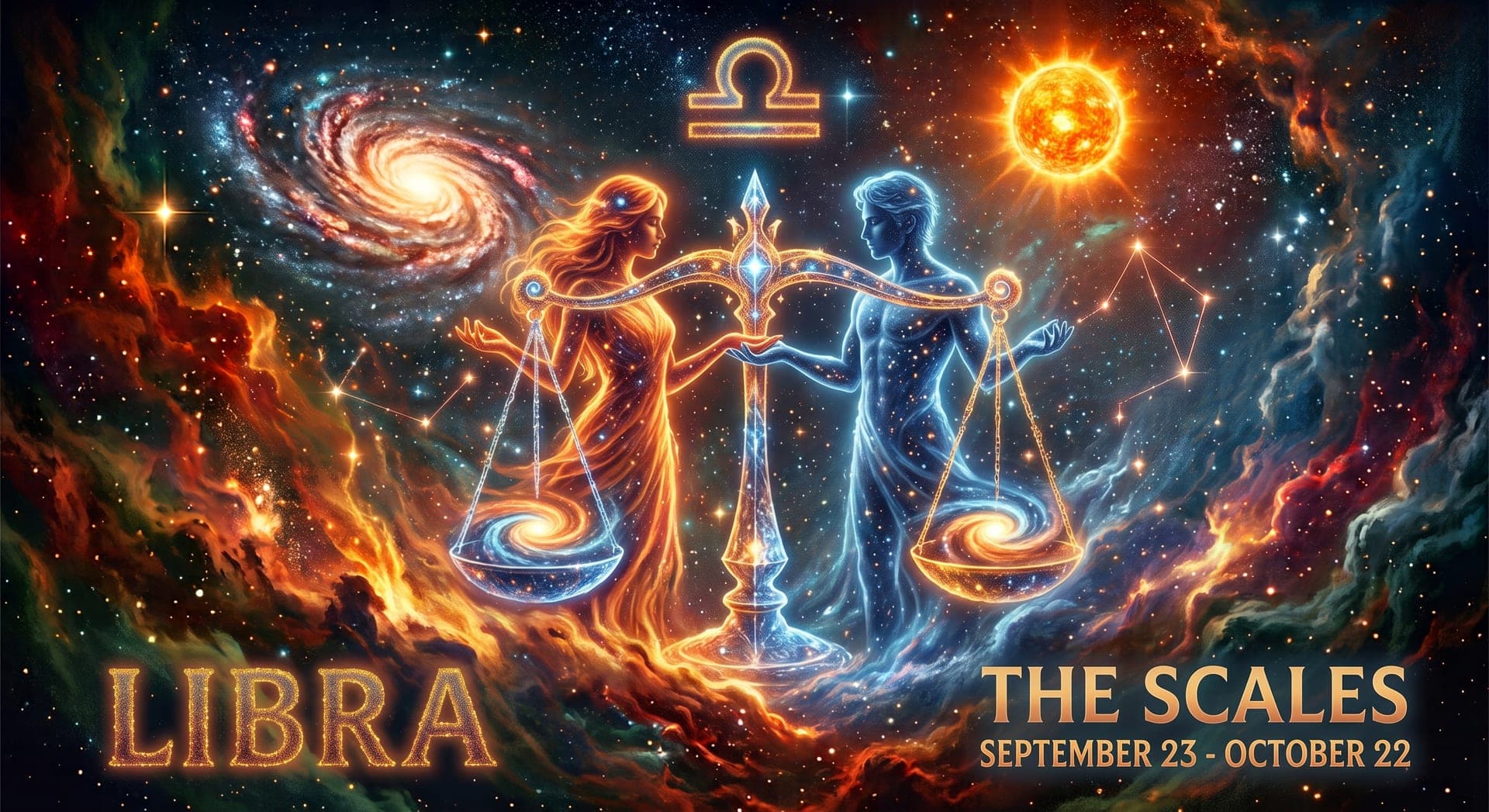
Libra, the seventh sign of the zodiac, spans September 23 to October 22 and is symbolized by the scales, the only zodiac symbol representing an inanimate object rather than a living creature, reflecting the sign's deep concern with balance, fairness, and justice. Ruled by Venus, the planet of love and beauty, Libra shares Taurus's appreciation for aesthetics and pleasure but channels it primarily through relationships, partnership, and social harmony. As an Air sign, Libra approaches the world intellectually and socially, valuing thoughtful conversation and diplomatic problem-solving over confrontation. Its Cardinal modality places it at the very start of autumn, beginning right at the equinox when day and night briefly achieve perfect balance. People born under this sign are often natural mediators, drawn to fairness and equilibrium in their relationships and surroundings, sometimes to the point of struggling to make decisions that might upset that balance. Libra's charm, diplomacy, and genuine desire to see all sides of an issue make it a valued friend and partner, even as its conflict-avoidance can occasionally leave real problems unresolved.
Personality Traits
Strengths
- Strong sense of fairness and justice
- Diplomatic peacemaker
- Charming and sociable
- Appreciates beauty and harmony
- Excellent at seeing multiple perspectives
Weaknesses
- Notoriously indecisive
- Conflict-avoidant to a fault
- Can be superficial
- People-pleasing tendencies
- Struggles with confrontation
Compatible Signs
Fun Facts
- Libra is the only zodiac sign represented by an inanimate object, the scales, rather than an animal or person.
- Libra's scales symbolize balance and justice, echoing the sign's association with fairness, harmony, and diplomacy.
- Venus, Libra's ruling planet, gives the sign its love of beauty, art, and romantic partnership, similar to Taurus but expressed through relationships rather than material comfort.
- As a Cardinal sign, Libra initiates autumn, beginning at the September equinox, when day and night are of equal length, fitting for a sign obsessed with balance.
- Notable Libras include Mahatma Gandhi, Kim Kardashian, John Lennon, and Will Smith.
Born on October 8
- 1807
Harriet Taylor Mill
English philosopher and women's rights advocate whose ideas on gender equality shaped the work of her collaborator and eventual husband, John Stuart Mill
- 1895
Juan Peron
President of Argentina
- 1917
Rodney Robert Porter
English biochemist who shared the Nobel Prize in Physiology or Medicine for determining the chemical structure of antibodies
- 1919
Kiichi Miyazawa
Prime Minister of Japan
- 1920
Frank Herbert
American author of "Dune"
- 1929
Betty Boothroyd
English politician who became the first woman to serve as Speaker of the British House of Commons
- 1932
Ray Reardon
Welsh snooker player nicknamed 'Dracula' who won six World Championship titles
- 1941
Jesse Jackson
American civil rights leader
- 1943
Chevy Chase
American comedian and actor
- 1943
R. L. Stine
American author of the "Goosebumps" series
- 1949
Sigourney Weaver
American actress known for "Alien"
- 1949
Hamish Stuart
Scottish singer, guitarist, and songwriter, a founding member of the funk and soul band Average White Band
- 1970
Sadiq Khan
English lawyer and Labour politician who became the first Muslim Mayor of London
- 1970
Anne-Marie Duff
English actress known for roles in the television series Shameless and films including The Virgin Queen
- 1997
Josh Kerr
Scottish middle-distance runner and Olympic medalist in the 1,500 metres
On This Day in History
- 316
Constantine I defeats co-emperor Licinius in battle, forcing him to cede significant European territories.
Constantine's forces defeated his rival co-emperor Licinius in the first major military confrontation between the two, forcing Licinius to cede substantial European territory and setting the stage for their eventual final showdown, which Constantine won several years later to become sole ruler of a reunified Roman Empire.
- 451
The Council of Chalcedon's first session commences, a major early Christian church council.
Bishops and church leaders convened at Chalcedon near Constantinople to address ongoing theological disputes regarding the nature of Christ, a council whose eventual conclusions were accepted by most Christian churches but rejected by several important eastern churches, contributing to lasting theological divisions within Christianity that persist to this day.
- 1200
Isabella of Angoulême is crowned queen consort of England as the second wife of King John.
Isabella had married John only two months earlier, a match that scandalized Europe since she was already betrothed to Hugh IX of Lusignan, a powerful French nobleman. The broken engagement helped trigger a war with France that cost John much of his continental territory. Isabella later became mother to Henry III and, after John's death, returned to France to marry her original fiancé's son.
- 1480
The Great Stand on the Ugra River ends Tatar dominion over Moscow without a major battle.
A tense standoff between Moscow's forces under Ivan III and an invading Tatar army along the Ugra River ended without significant fighting when the Tatar forces withdrew, an event traditionally regarded as marking the definitive end of over two centuries of Mongol-Tatar dominance over Russian principalities.
- 1573
The Spanish siege of Alkmaar concludes with the first Dutch victory of the Eighty Years' War.
After a grueling seven-month siege that decimated the Dutch defenders through starvation and disease, Spanish forces finally abandoned their assault on Alkmaar, marking the first significant Dutch military success against Spain during the Eighty Years' War and giving rise to the enduring Dutch phrase "victory begins at Alkmaar."
- 1829
Stephenson's Rocket wins the Rainhill Trials, demonstrating steam locomotion's practicality for railways.
Engineer George Stephenson's locomotive "Rocket" decisively won the Rainhill Trials competition, demonstrating superior speed and reliability compared to rival steam engine designs, a triumph that led directly to Rocket's design being adopted for the pioneering Liverpool and Manchester Railway and establishing key engineering principles used in steam locomotives for the following century.
- 1829
Robert Stephenson's locomotive Rocket wins the Rainhill Trials, held near Liverpool to select the engine for the new railway.
The trials were staged by the Liverpool and Manchester Railway to prove that steam locomotives, rather than stationary engines or horses, were the best way to power the world's first inter-city railway. Rocket's multi-tube boiler design let it reach speeds of nearly 30 miles per hour, far outpacing its rivals. Its success established the basic layout used by steam locomotives for the next century.
- 1856
The Second Opium War begins with the Arrow Incident between Britain and China.
A British merchant ship, the Arrow, was boarded by Chinese officials investigating suspected piracy, and Britain used the incident, along with alleged insults to the British flag, as justification to launch renewed military action against China, reopening hostilities that expanded foreign trading privileges and territorial concessions following China's defeat.
- 1856
The Second Opium War begins after Chinese officials board and seize the British-registered ship Arrow in Guangzhou harbour.
The Arrow, a Chinese-owned vessel flying a British flag, was boarded by Qing officials searching for a suspected pirate, who lowered the flag and arrested most of its Chinese crew. Britain, joined later by France, used the incident as a pretext to force China into greater trade concessions. The resulting war ended in 1860 with treaties that opened more Chinese ports and legalized the opium trade.
- 1871
Devastating fires break out simultaneously across the American Midwest, including the Great Chicago Fire.
A combination of severe drought conditions and strong winds fueled numerous simultaneous fires across Wisconsin, Michigan, and Illinois, including the devastating Great Chicago Fire, which destroyed a substantial portion of the city and killed an estimated 300 people, though the lesser-known Peshtigo fire in Wisconsin actually claimed far more lives.
- 1912
Montenegro declares war on the Ottoman Empire, initiating the First Balkan War.
Montenegro's declaration of war against the weakening Ottoman Empire initiated the First Balkan War, in which an alliance of Balkan states successfully expelled Ottoman forces from most of their remaining European territory, dramatically reshaping the map of southeastern Europe just before the outbreak of World War I.
- 1918
US Army Corporal Alvin C. York leads an attack that kills 28 German soldiers and captures 132 more during the Meuse-Argonne offensive.
York, a reluctant draftee from Tennessee who had initially sought conscientious objector status, took command after his sergeant fell in a firefight in the Argonne Forest. Using marksmanship learned hunting turkeys as a boy, he silenced a line of German machine-gun nests almost single-handedly. His actions, among the most celebrated of American service in World War I, earned him the Medal of Honor.
- 1939
Nazi Germany formally annexes western Poland, incorporating it directly into the German Reich weeks after invading the country.
Following the joint German-Soviet conquest of Poland in September 1939, Adolf Hitler declared the western Polish provinces, including regions around Poznań and Łódź, annexed territory rather than occupied land. The move was accompanied by mass expulsions of Poles and Jews to make way for German settlers. The remainder of central Poland was organized as the so-called General Government under Nazi administration.
- 1952
The Harrow and Wealdstone rail crash in England kills 112 people in one of Britain's worst peacetime railway disasters.
A night sleeper train from Perth ran into the back of a stationary local train at Harrow and Wealdstone station in northwest London, and moments later an express train travelling the other way ploughed into the wreckage. The triple collision killed 112 people and injured many more, making it the second-deadliest train crash in British history. The disaster prompted a major review of railway signalling and safety practices.
- 1967
Revolutionary leader Che Guevara and his remaining forces are captured in Bolivia.
Bolivian army units, aided by American intelligence assistance, captured the wounded revolutionary Che Guevara following a prolonged guerrilla campaign attempting to spread Cuban-style revolution throughout South America, effectively ending his ambitious but ultimately unsuccessful attempt to ignite a broader continental uprising.
- 1970
Soviet dissident writer Aleksandr Solzhenitsyn is awarded the Nobel Prize in Literature for his unflinching depictions of Soviet repression.
Solzhenitsyn had already served eight years in Soviet labor camps, an experience that shaped novels such as One Day in the Life of Ivan Denisovich and The Gulag Archipelago. Fearing he would not be allowed to return if he traveled to Stockholm, he did not collect the prize in person until 1974, after being expelled from the Soviet Union. The award intensified official hostility toward him at home.
- 1973
During the Yom Kippur War, Israel loses more than 150 tanks in a failed assault on Egyptian-held positions along the Suez Canal.
The attack came days after Egypt and Syria launched a surprise offensive on the Jewish holy day of Yom Kippur, catching Israeli forces off guard. Egyptian troops, dug in on the canal's east bank and armed with Soviet-supplied anti-tank missiles, inflicted heavy losses on advancing Israeli armor. The war ultimately ended in a ceasefire brokered with US and Soviet involvement, reshaping Middle East diplomacy for years afterward.
- 1982
Poland's communist government formally bans Solidarity, the independent trade union that had grown into a mass opposition movement.
Solidarity, led by shipyard electrician Lech Wałęsa, had won millions of members after its founding in 1980 before martial law was declared in December 1981 to suppress it. Outlawing the union alongside all other independent trade unions was meant to crush organized dissent for good. Instead, Solidarity survived underground and returned to legality in 1989, helping negotiate the end of communist rule in Poland.
- 2005
A major earthquake in Kashmir kills tens of thousands of people and displaces millions.
A powerful magnitude 7.6 earthquake struck the mountainous Kashmir region straddling Pakistan and India, collapsing poorly constructed buildings across a wide area and killing tens of thousands of people, with the remote, difficult terrain significantly complicating rescue and relief efforts in the disaster's aftermath.
- 2005
A magnitude 7.6 earthquake strikes the Kashmir region, leaving tens of thousands dead and millions homeless across Pakistan and India.
The quake's epicenter lay near Muzaffarabad in Pakistani-administered Kashmir, an area of steep terrain and poorly reinforced buildings, including many schools that collapsed on students. Estimates put the death toll between roughly 86,000 and 87,000, with about 69,000 to 75,000 injured and some 2.8 million left without homes as winter approached. It remains one of the deadliest earthquakes in South Asian history.