What’s Observed on October 9
Born on October 9: Libra ♎
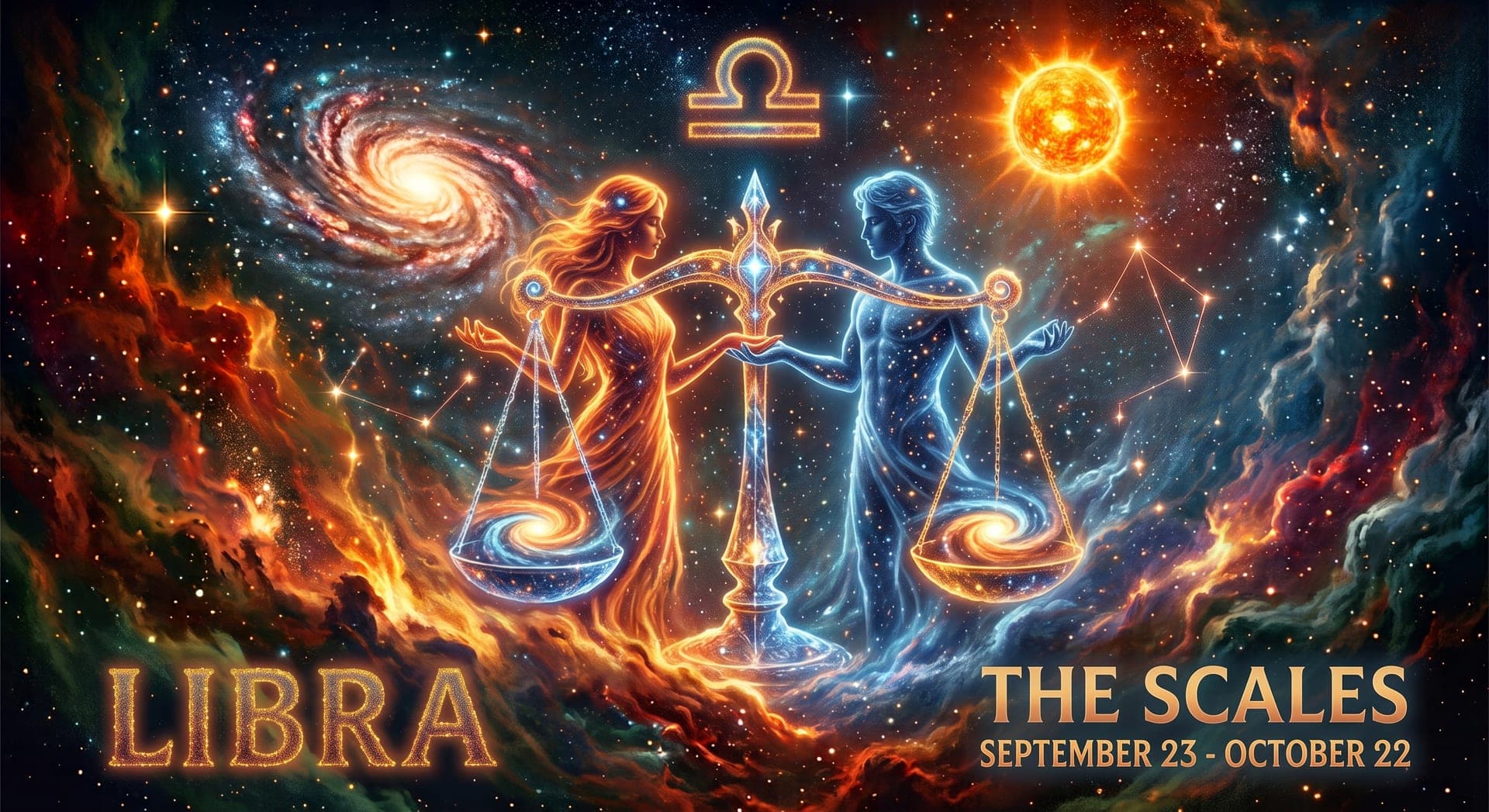
Libra, the seventh sign of the zodiac, spans September 23 to October 22 and is symbolized by the scales, the only zodiac symbol representing an inanimate object rather than a living creature, reflecting the sign's deep concern with balance, fairness, and justice. Ruled by Venus, the planet of love and beauty, Libra shares Taurus's appreciation for aesthetics and pleasure but channels it primarily through relationships, partnership, and social harmony. As an Air sign, Libra approaches the world intellectually and socially, valuing thoughtful conversation and diplomatic problem-solving over confrontation. Its Cardinal modality places it at the very start of autumn, beginning right at the equinox when day and night briefly achieve perfect balance. People born under this sign are often natural mediators, drawn to fairness and equilibrium in their relationships and surroundings, sometimes to the point of struggling to make decisions that might upset that balance. Libra's charm, diplomacy, and genuine desire to see all sides of an issue make it a valued friend and partner, even as its conflict-avoidance can occasionally leave real problems unresolved.
Personality Traits
Strengths
- Strong sense of fairness and justice
- Diplomatic peacemaker
- Charming and sociable
- Appreciates beauty and harmony
- Excellent at seeing multiple perspectives
Weaknesses
- Notoriously indecisive
- Conflict-avoidant to a fault
- Can be superficial
- People-pleasing tendencies
- Struggles with confrontation
Compatible Signs
Fun Facts
- Libra is the only zodiac sign represented by an inanimate object, the scales, rather than an animal or person.
- Libra's scales symbolize balance and justice, echoing the sign's association with fairness, harmony, and diplomacy.
- Venus, Libra's ruling planet, gives the sign its love of beauty, art, and romantic partnership, similar to Taurus but expressed through relationships rather than material comfort.
- As a Cardinal sign, Libra initiates autumn, beginning at the September equinox, when day and night are of equal length, fitting for a sign obsessed with balance.
- Notable Libras include Mahatma Gandhi, Kim Kardashian, John Lennon, and Will Smith.
Born on October 9
- 1835
Camille Saint-Saens
French composer
- 1859
Alfred Dreyfus
French military officer at the center of the Dreyfus Affair
- 1900
Alastair Sim
Scottish actor best remembered for his portrayal of Ebenezer Scrooge in the 1951 film adaptation of A Christmas Carol
- 1933
Peter Mansfield
English physicist who shared the Nobel Prize in Physiology or Medicine for developing techniques behind magnetic resonance imaging
- 1936
Brian Blessed
English actor known for his booming voice and roles in Flash Gordon, I, Claudius, and Blackadder
- 1940
John Lennon
English singer, songwriter, and guitarist who co-founded the Beatles and later pursued a solo career as a peace activist
- 1941
Brian Lamb
American founder of C-SPAN
- 1944
John Entwistle
English bass player and songwriter, a founding member of the rock band the Who
- 1952
Sharon Osbourne
English television personality and music manager
- 1955
Steve Ovett
English middle-distance runner who won Olympic gold in the 800 metres at the 1980 Moscow Games
- 1966
David Cameron
English politician who served as Prime Minister of the United Kingdom from 2010 to 2016
- 1969
PJ Harvey
English singer-songwriter and musician known for her raw, genre-spanning albums and two Mercury Prize wins
- 1984
Marie Kondo
Japanese organizing consultant and author
On This Day in History
- 768
Carloman I and Charlemagne are crowned joint kings of the Franks following their father's death.
Following the death of their father Pepin the Short, his two sons were crowned joint kings of the Frankish realm, dividing the kingdom between them according to Frankish custom. Carloman died just three years later, leaving Charlemagne as sole ruler, free to embark on the extensive military campaigns and cultural revival that defined his transformative reign.
- 1238
James I of Aragon establishes the Kingdom of Valencia after capturing it from Moorish rule.
Following his conquest of Moorish-held Valencia during the Reconquista, King James I of Aragon established it as a separate kingdom under the crown of Aragon, granting the region distinct legal privileges and fostering a Kingdom of Valencia that maintained its own institutions and identity for centuries within the broader Spanish crown.
- 1604
Kepler's Supernova becomes the most recent supernova observed within the Milky Way galaxy.
A brilliant supernova appeared in the constellation Ophiuchus, visible to the naked eye for over a year and observed extensively by astronomer Johannes Kepler, whose detailed observations and subsequent writings made it the most thoroughly documented supernova of the era. It remains the most recent supernova confirmed to have occurred within the Milky Way visible from Earth.
- 1701
Connecticut's Collegiate School, later renamed Yale University, is chartered.
Connecticut colonial ministers established a small collegiate school intended to train clergy, later relocating to New Haven and being renamed Yale College in honor of a benefactor, Elihu Yale, whose donation helped secure the struggling institution's finances. Yale grew into one of the most prestigious universities in the United States.
- 1799
The Royal Navy frigate HMS Lutine sinks in a storm off the Dutch coast, taking down roughly £1.2 million in gold and silver.
Lutine was carrying bullion to shore up confidence in the Amsterdam financial markets when it was wrecked off the Netherlands with the loss of nearly its entire crew. Salvage attempts over the following two centuries recovered only a fraction of the treasure. The ship's bell, later recovered and hung at Lloyd's of London, became a famous symbol of the marine insurance market, traditionally rung to announce major shipping news.
- 1812
American naval forces capture the British ships HMS Detroit and HMS Caledonia in a raid on Lake Erie during the War of 1812.
Lieutenant Jesse Elliott led a nighttime boarding raid on the two British vessels as they lay at anchor near Fort Erie, seizing both without significant loss. The daring capture boosted American morale on the Great Lakes frontier and foreshadowed the more decisive US victory at the Battle of Lake Erie less than a year later. The loss weakened British naval control of the vital lake supply routes.
- 1831
Ioannis Kapodistrias, Greece's first head of state, is assassinated.
Ioannis Kapodistrias, a former Russian diplomat who became the first head of state of newly independent Greece, was assassinated by political rivals amid factional disputes over the young nation's governance, a killing that plunged Greece into a period of political instability before the eventual establishment of a monarchy under a Bavarian prince.
- 1834
The Dublin and Kingstown Railway opens, becoming the first public railway on the island of Ireland, then part of the United Kingdom.
Built to link Dublin with the harbour town of Kingstown, now Dún Laoghaire, the line was engineered with help from railway pioneers active across Britain and ran along the shore of Dublin Bay. It predated most railways on the European continent and helped spark a wave of Irish railway construction over the following decades. The line remains in operation today as part of Dublin's DART commuter network.
- 1874
The Universal Postal Union is established through the Treaty of Bern, standardizing international mail.
Representatives from numerous countries meeting in the Swiss capital signed a treaty establishing the Universal Postal Union, creating standardized rules that dramatically simplified the exchange of international mail between member nations, replacing a previous patchwork of separate bilateral postal agreements between individual countries.
- 1900
The Cook Islands become a British territory in the South Pacific, shortly before being transferred to New Zealand's administration.
The islands had already been under informal British protection since the 1880s, largely to preempt French annexation from nearby Tahiti. Formal British sovereignty was proclaimed in October 1900, but administration passed to New Zealand the following year, a relationship that evolved into the islands' current self-governing status in free association with New Zealand. The move was part of a broader wave of British Pacific expansion in that era.
- 1911
An accidental bomb explosion triggers the Wuchang Uprising against China's Qing dynasty.
An accidental explosion at a bomb-making workshop operated by revolutionaries plotting against the Qing dynasty alerted authorities and forced the conspirators into premature action, triggering an uprising in the city of Wuchang that unexpectedly succeeded and rapidly spread, ultimately leading to the collapse of over two thousand years of Chinese imperial rule.
- 1934
King Alexander I of Yugoslavia and French foreign minister Louis Barthou are assassinated by a Croatian nationalist gunman in Marseille.
Alexander was on a state visit to France to strengthen an alliance against a resurgent Germany when Vlado Chernozemski, a gunman linked to the Bulgarian and Croatian Ustaše nationalist movements, shot him from the running board of his car. The assassination, one of the first captured on film, destabilized the Balkans and weakened the network of French-backed alliances meant to contain Nazi Germany.
- 1942
Australia's Statute of Westminster Adoption Act receives royal assent, formally confirming the country's legislative independence from Britain.
The original Statute of Westminster, passed by the British Parliament in 1931, had already granted Dominions like Australia and Canada full legal authority over their own affairs, but Australia had not yet formally adopted it. Backdated to the outbreak of the war in 1939, the Act clarified Australia's power to legislate on matters such as wartime defense without needing British approval. It marked a key step in the country's constitutional evolution within the Commonwealth.
- 1962
Uganda gains independence from Britain, becoming a self-governing member of the Commonwealth under Prime Minister Milton Obote.
Uganda had been a British protectorate since the 1890s, administered indirectly through existing kingdoms such as Buganda. Independence came after a series of constitutional conferences in London that negotiated power-sharing between the central government and the traditional kingdoms. Milton Obote became the country's first prime minister, though tensions between his government and the kingdoms, especially Buganda, would soon destabilize the new nation.
- 1967
Ernesto "Che" Guevara is executed in Bolivia following his capture the previous day.
Wounded and captured by Bolivian forces the previous day, revolutionary Che Guevara was executed on the orders of Bolivian officials acting with American intelligence support, an act intended to eliminate him as a symbol of revolutionary resistance but which instead helped transform him into an enduring international icon of rebellion and radical politics.
- 1984
"Thomas the Tank Engine & Friends" premieres on British television.
The children's television series based on the Reverend Wilbert Awdry's beloved book characters premiered in Britain, featuring anthropomorphic steam locomotives on the fictional island of Sodor, and the show went on to achieve enormous international popularity among young children for decades afterward, spawning films and merchandise worldwide.
- 1984
Thomas the Tank Engine & Friends, based on the Railway Series books, makes its television debut on Britain's ITV network.
The stop-motion animated series adapted stories originally written by the Reverend Wilbert Awdry for his son, and used model railway sets and narration by actor Ringo Starr for its early British episodes. It became a lasting children's television institution, spawning decades of spin-off merchandise, films, and international adaptations. The show introduced generations of children to its cast of anthropomorphic steam engines led by the title character.
- 1986
Andrew Lloyd Webber's musical The Phantom of the Opera opens at Her Majesty's Theatre in London's West End.
Starring Michael Crawford and Sarah Brightman in the lead roles, the production was based on Gaston Leroux's 1910 novel about a disfigured composer haunting the Paris Opera House. It went on to become one of the longest-running and highest-grossing musicals in theatre history, still playing at Her Majesty's Theatre decades later. The show also launched a hugely successful Broadway production and numerous international tours.
- 2006
North Korea conducts its first nuclear weapons test, confirming it had joined the small group of nuclear-armed states.
The underground test, carried out near Kilju in the country's northeast, was detected by seismic monitors worldwide and drew swift condemnation, including a unanimous UN Security Council resolution imposing sanctions. Estimates of the device's yield were relatively low compared with other nuclear-armed states' first tests, prompting speculation about a partial failure. It marked a major turning point in the decades-long standoff over North Korea's nuclear ambitions.
- 2024
Hurricane Milton makes landfall in Florida, causing an estimated $34.3 billion in damages.
Hurricane Milton rapidly intensified before making landfall on Florida's Gulf Coast, causing widespread wind damage, storm surge flooding, and a substantial outbreak of tornadoes across the state, compounding recovery efforts still underway from Hurricane Helene, which had struck the same region just weeks earlier.