What’s Observed on October 4
Born on October 4: Libra ♎
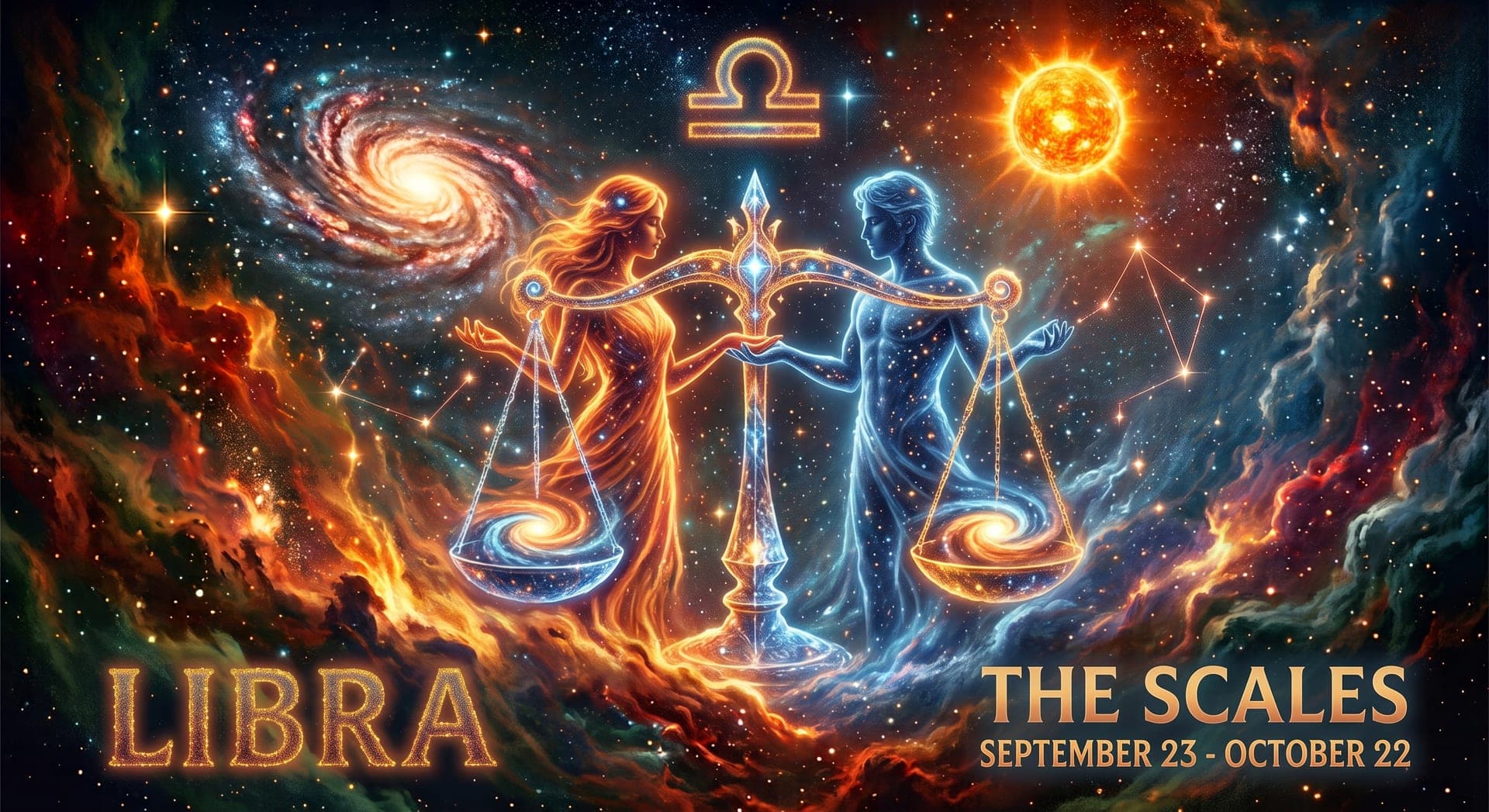
Libra, the seventh sign of the zodiac, spans September 23 to October 22 and is symbolized by the scales, the only zodiac symbol representing an inanimate object rather than a living creature, reflecting the sign's deep concern with balance, fairness, and justice. Ruled by Venus, the planet of love and beauty, Libra shares Taurus's appreciation for aesthetics and pleasure but channels it primarily through relationships, partnership, and social harmony. As an Air sign, Libra approaches the world intellectually and socially, valuing thoughtful conversation and diplomatic problem-solving over confrontation. Its Cardinal modality places it at the very start of autumn, beginning right at the equinox when day and night briefly achieve perfect balance. People born under this sign are often natural mediators, drawn to fairness and equilibrium in their relationships and surroundings, sometimes to the point of struggling to make decisions that might upset that balance. Libra's charm, diplomacy, and genuine desire to see all sides of an issue make it a valued friend and partner, even as its conflict-avoidance can occasionally leave real problems unresolved.
Personality Traits
Strengths
- Strong sense of fairness and justice
- Diplomatic peacemaker
- Charming and sociable
- Appreciates beauty and harmony
- Excellent at seeing multiple perspectives
Weaknesses
- Notoriously indecisive
- Conflict-avoidant to a fault
- Can be superficial
- People-pleasing tendencies
- Struggles with confrontation
Compatible Signs
Fun Facts
- Libra is the only zodiac sign represented by an inanimate object, the scales, rather than an animal or person.
- Libra's scales symbolize balance and justice, echoing the sign's association with fairness, harmony, and diplomacy.
- Venus, Libra's ruling planet, gives the sign its love of beauty, art, and romantic partnership, similar to Taurus but expressed through relationships rather than material comfort.
- As a Cardinal sign, Libra initiates autumn, beginning at the September equinox, when day and night are of equal length, fitting for a sign obsessed with balance.
- Notable Libras include Mahatma Gandhi, Kim Kardashian, John Lennon, and Will Smith.
Born on October 4
- 1626
Richard Cromwell
English statesman who succeeded his father Oliver Cromwell as Lord Protector of England, Scotland and Ireland, though he held power for less than a year before the monarchy was restored.
- 1814
Jean-Francois Millet
French painter known for rural scenes
- 1822
Rutherford B. Hayes
19th President of the United States
- 1895
Buster Keaton
American silent film actor and director
- 1923
Charlton Heston
American actor known for "Ben-Hur"
- 1931
Terence Conran
English designer, restaurateur and retailer who founded Habitat and transformed British attitudes toward home design and everyday style.
- 1931
Basil D'Oliveira
South African-born English cricketer whose exclusion from a tour of apartheid South Africa on racial grounds triggered the D'Oliveira affair, a major turning point in the international sporting boycott of apartheid.
- 1937
Jackie Collins
English novelist whose glamorous, bestselling books about Hollywood and high society sold hundreds of millions of copies worldwide.
- 1946
Susan Sarandon
American actress
- 1947
Ann Widdecombe
British Conservative politician and broadcaster known for her outspoken views during more than two decades as a Member of Parliament.
- 1958
Anneka Rice
English television presenter best known for hosting the adventure game show Treasure Hunt in the 1980s.
- 1960
Henry Worsley
British Army officer and polar explorer who retraced Ernest Shackleton's Antarctic expeditions and died in 2016 during an attempted solo, unsupported crossing of Antarctica.
- 1976
Alicia Silverstone
American actress
- 1988
Derrick Rose
American professional basketball player
- 1989
Dakota Johnson
American actress
On This Day in History
- 23
Rebels sack the Chinese capital Chang'an during a peasant rebellion against the Xin dynasty.
During a period of severe economic hardship and famine under the unpopular usurper Wang Mang, peasant rebels stormed and sacked the capital city of Chang'an, one of ancient China's largest and most important urban centers, contributing to the collapse of Wang Mang's short-lived Xin dynasty and paving the way for the restoration of the Han dynasty.
- 1209
Otto IV is crowned Holy Roman Emperor by Pope Innocent III.
Otto IV, a member of the Welf dynasty, received the imperial crown from Pope Innocent III following a prolonged and contested succession dispute within the Holy Roman Empire. His reign proved turbulent, marked by ongoing conflict with rival claimants and eventually ending in his deposition after a significant military defeat, illustrating the frequently unstable nature of medieval imperial succession.
- 1511
The Holy League forms, uniting Aragon, the Papal States, and Venice against France.
Pope Julius II, Ferdinand II of Aragon, and Venice formed the Holy League specifically to counter growing French influence in Italy during the ongoing Italian Wars, later expanding to include England and the Holy Roman Empire. The shifting alliance ultimately succeeded in driving French forces from much of northern Italy, though at the cost of years of continued regional warfare.
- 1535
The Coverdale Bible is printed, the first complete English translation of the Bible.
Miles Coverdale produced the first complete printed translation of the Bible into English, drawing significantly on earlier partial translations by William Tyndale, who had been executed for heresy before completing his own full translation. The Coverdale Bible helped establish a foundation for later, more widely used English translations, including the eventual King James Version.
- 1535
The Coverdale Bible, the first complete printed translation of the Bible into English, was published.
Produced by Miles Coverdale and dedicated to King Henry VIII, it drew on William Tyndale's earlier partial translations along with Latin and German sources to render the entire Bible in English for the first time. Its publication marked a pivotal moment in the English Reformation, making scripture directly accessible to English readers outside the Latin-literate clergy.
- 1582
Pope Gregory XIII introduces the Gregorian calendar, replacing the Julian calendar.
Concerned that the existing Julian calendar had drifted significantly out of alignment with the astronomical seasons over the centuries, Pope Gregory XIII issued a papal bull introducing a revised calendar system with refined leap year rules, along with a one-time adjustment skipping ten days. Catholic countries adopted the change relatively quickly, while Protestant and Orthodox nations often delayed adoption for decades or even centuries.
- 1602
A combined English and Dutch fleet defeated a squadron of Spanish galleys in the English Channel.
The clash came amid the long Anglo-Spanish War, as England and the rebellious Dutch provinces cooperated against Spanish naval power threatening trade routes and coastal towns. The victory reinforced England's growing confidence as a maritime power during the final years of Elizabeth I's reign.
- 1777
American troops under George Washington are repelled by British forces under William Howe at the Battle of Germantown.
British General William Howe's forces repelled a surprise dawn attack by Washington's Continental Army near Philadelphia, with thick fog contributing to confusion and friendly-fire incidents among the American troops during the complex multi-pronged assault. Despite the tactical defeat, the ambitious attempt demonstrated growing American military sophistication and helped convince France of the colonies' seriousness in pursuing independence.
- 1777
British and Hessian forces repelled a surprise attack by George Washington's Continental Army at the Battle of Germantown.
Washington's ambitious four-column night march aimed to strike the British garrison outside Philadelphia, but dense fog and confused coordination allowed the defenders to hold their ground. Despite the defeat, the boldness of the American assault impressed European observers and helped persuade France to formally support the American cause.
- 1795
Napoleon Bonaparte rises to prominence by suppressing a royalist uprising in Paris.
As royalist insurgents threatened the young French Republic's National Convention, a relatively unknown young artillery officer named Napoleon Bonaparte was called upon to defend the government, famously employing cannon fire, described as "a whiff of grapeshot," to disperse the crowds. The decisive action launched Napoleon's rapid rise to national prominence and eventual seizure of power.
- 1830
The Belgian Revolution becomes official as a provisional government secedes from the Netherlands.
Following months of growing unrest and an uprising centered in Brussels against Dutch rule, a provisional Belgian government formally declared independence from the Kingdom of the Netherlands, an action later recognized internationally through the London Conference the following year, establishing Belgium as a new sovereign European nation.
- 1853
The Ottoman Empire declared war on Russia, marking the beginning of the Crimean War.
The conflict arose from disputes over Russian influence in Ottoman territory and protection of Christian holy sites in Palestine, escalating the following year when Britain and France entered on the Ottoman side to check Russian expansion. The war became notorious for its logistical failures and for pioneering modern battlefield nursing under Florence Nightingale, cementing its place in British national memory.
- 1883
The Orient Express makes its inaugural journey across Europe.
The Orient Express departed Paris on its first journey toward Constantinople, offering unprecedented luxury rail travel across Europe and quickly becoming a legendary symbol of glamorous international travel that later inspired numerous works of literature and film, most famously Agatha Christie's "Murder on the Orient Express."
- 1883
The Boys' Brigade held its first meeting in Glasgow, Scotland.
Founded by William Alexander Smith to combine Christian values with the discipline and drill of military-style organisation, the Boys' Brigade became the model for later youth movements, including Robert Baden-Powell's Boy Scouts. It remains active today across the UK and dozens of other countries.
- 1917
British, Australian and New Zealand troops captured Broodseinde Ridge in Flanders during the Third Battle of Ypres.
The attack, part of the wider Passchendaele campaign, used a limited "bite and hold" advance backed by heavy artillery to inflict a serious defeat on the German defenders, prompting alarm within the German high command. Torrential rain soon afterward turned the battlefield to mud, halting further Allied progress and contributing to the campaign's grim reputation.
- 1936
Anti-fascist demonstrators clashed with police in the Battle of Cable Street in London's East End.
Tens of thousands of local residents, trade unionists, and Jewish, Irish and socialist groups blocked a planned march by Oswald Mosley's British Union of Fascists through a heavily Jewish neighbourhood. The successful blockade became a celebrated symbol of community resistance to fascism in interwar Britain.
- 1957
The Soviet Union launches Sputnik 1, the first artificial satellite to orbit Earth.
The Soviet Union stunned the world by launching Sputnik 1, a simple beeping metal sphere that became the first artificial satellite to orbit Earth, dramatically demonstrating Soviet rocket capabilities and triggering the Space Race with the United States. The launch prompted significant American investment in science education and space technology, ultimately leading to the creation of NASA the following year.
- 1957
The Soviet Union launched Sputnik 1, the world's first artificial satellite, into orbit.
The beach-ball-sized satellite's beeping radio signal, audible to amateur radio operators worldwide, stunned the American public and triggered the Space Race between the US and Soviet Union. Its launch is widely regarded as the opening event of the Space Age and spurred major increases in Western science and technology funding, including the creation of NASA.
- 1966
The British protectorate of Basutoland gained independence, becoming the Kingdom of Lesotho.
Landlocked and entirely surrounded by South Africa, the former protectorate had been under British administration since the 19th century after King Moshoeshoe I sought British protection from Boer and Zulu incursions. Independence came under a constitutional monarchy with Moshoeshoe II as king, and Lesotho remains a member of the Commonwealth.
- 1983
British driver Richard Noble set a new world land speed record in his jet-powered car Thrust2.
Racing across Nevada's Black Rock Desert, Noble reached over 633 mph (1,019 km/h), reclaiming the record for Britain after more than a decade of American dominance. The achievement built on a long British tradition of land speed record pursuits and paved the way for the supersonic Thrust SSC record set in 1997.