What’s Observed on October 19
Born on October 19: Libra ♎
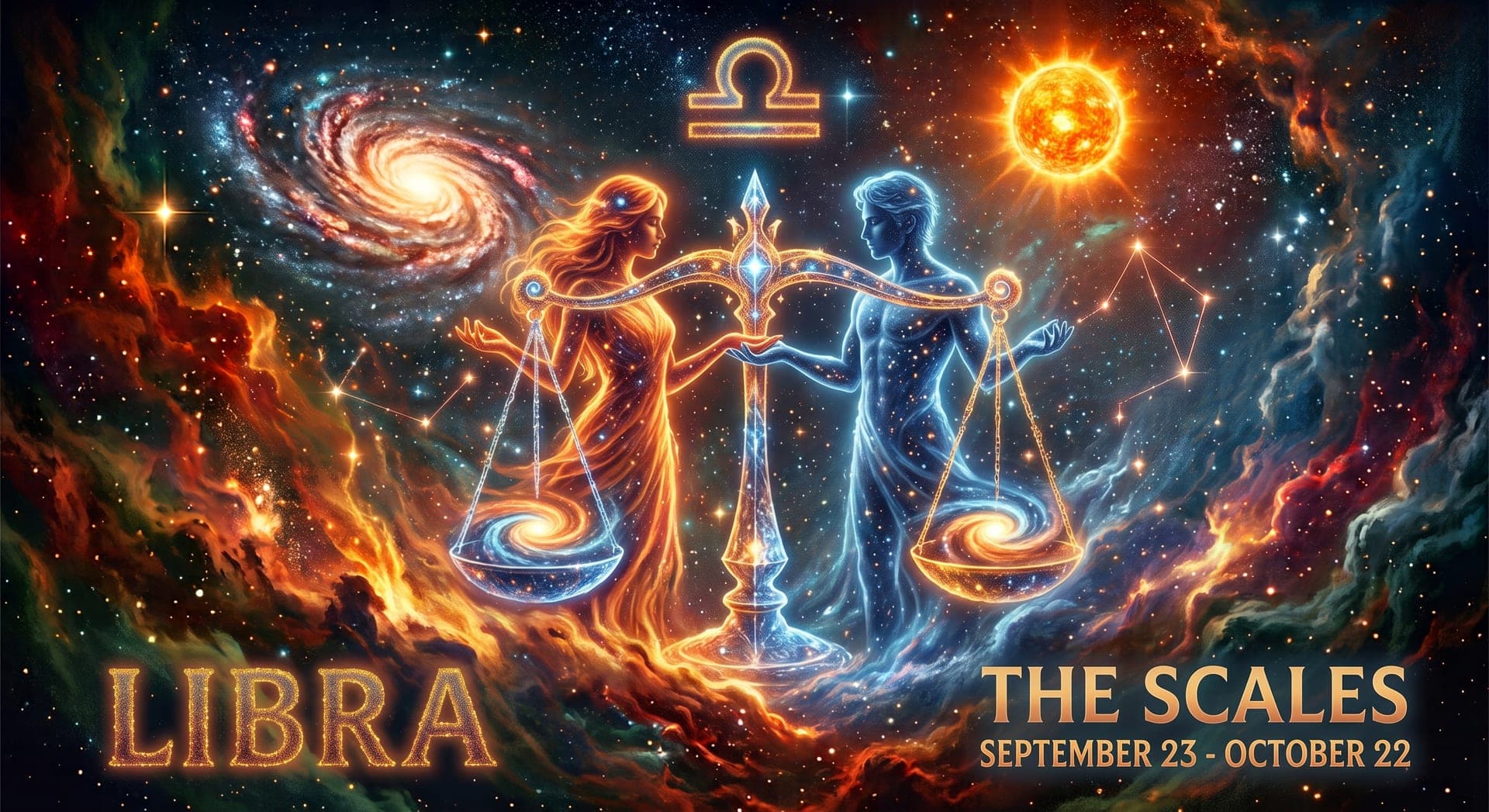
Libra, the seventh sign of the zodiac, spans September 23 to October 22 and is symbolized by the scales, the only zodiac symbol representing an inanimate object rather than a living creature, reflecting the sign's deep concern with balance, fairness, and justice. Ruled by Venus, the planet of love and beauty, Libra shares Taurus's appreciation for aesthetics and pleasure but channels it primarily through relationships, partnership, and social harmony. As an Air sign, Libra approaches the world intellectually and socially, valuing thoughtful conversation and diplomatic problem-solving over confrontation. Its Cardinal modality places it at the very start of autumn, beginning right at the equinox when day and night briefly achieve perfect balance. People born under this sign are often natural mediators, drawn to fairness and equilibrium in their relationships and surroundings, sometimes to the point of struggling to make decisions that might upset that balance. Libra's charm, diplomacy, and genuine desire to see all sides of an issue make it a valued friend and partner, even as its conflict-avoidance can occasionally leave real problems unresolved.
Personality Traits
Strengths
- Strong sense of fairness and justice
- Diplomatic peacemaker
- Charming and sociable
- Appreciates beauty and harmony
- Excellent at seeing multiple perspectives
Weaknesses
- Notoriously indecisive
- Conflict-avoidant to a fault
- Can be superficial
- People-pleasing tendencies
- Struggles with confrontation
Compatible Signs
Fun Facts
- Libra is the only zodiac sign represented by an inanimate object, the scales, rather than an animal or person.
- Libra's scales symbolize balance and justice, echoing the sign's association with fairness, harmony, and diplomacy.
- Venus, Libra's ruling planet, gives the sign its love of beauty, art, and romantic partnership, similar to Taurus but expressed through relationships rather than material comfort.
- As a Cardinal sign, Libra initiates autumn, beginning at the September equinox, when day and night are of equal length, fitting for a sign obsessed with balance.
- Notable Libras include Mahatma Gandhi, Kim Kardashian, John Lennon, and Will Smith.
Born on October 19
- 1605
Thomas Browne
English physician and author whose richly stylized prose works, including Religio Medici, blended science, philosophy, and faith.
- 1609
Gerrard Winstanley
English Protestant reformer and writer who co-founded the Diggers, an early agrarian movement advocating common ownership of land.
- 1910
Subrahmanyan Chandrasekhar
Indian-American astrophysicist and Nobel laureate
- 1916
Emil Gilels
Soviet classical pianist
- 1931
John le Carre
English spy novelist
- 1931
John le Carré
English author and former intelligence officer celebrated for espionage novels including Tinker Tailor Soldier Spy and The Spy Who Came in from the Cold.
- 1932
Robert Reed
American actor known for "The Brady Bunch"
- 1937
Peter Max
German-American pop artist
- 1940
Michael Gambon
Actor known for playing Dumbledore in "Harry Potter"
- 1945
John Lithgow
American actor
- 1945
Angus Deaton
Scottish-American economist awarded the Nobel Memorial Prize in Economic Sciences for his analysis of consumption, poverty, and welfare.
- 1946
Philip Pullman
English author best known for the His Dark Materials fantasy trilogy, beginning with Northern Lights.
- 1954
Sam Allardyce
English football manager known for lengthy spells at clubs including Bolton Wanderers and West Ham United, and a brief tenure managing the England national team.
- 1957
Karl Wallinger
Welsh singer-songwriter and multi-instrumentalist best known as the driving force behind the band World Party.
- 1969
Trey Parker
American animator who co-created "South Park"
On This Day in History
- 202 BCE
Roman legions under Scipio Africanus decisively defeat Hannibal Barca at the Battle of Zama, ending the Second Punic War.
Roman legions under Scipio Africanus decisively defeated Hannibal's Carthaginian army near Zama in North Africa, ending the sixteen-year Second Punic War and Hannibal's remarkable but ultimately unsuccessful invasion of Italy, cementing Rome's dominance over the western Mediterranean for centuries to come.
- 439
Vandal forces under King Gaiseric capture Carthage in North Africa.
Vandal forces under King Gaiseric captured the wealthy North African city of Carthage through subterfuge during a period of relative peace, establishing it as the capital of a powerful Vandal kingdom that later launched a notorious sack of Rome itself in 455.
- 1386
Heidelberg University holds its inaugural lecture, becoming Germany's oldest university.
Heidelberg University held its first lecture following its founding charter from the Elector Palatine Ruprecht I, establishing what remains Germany's oldest continuously operating university and an enduring center of academic scholarship in the Holy Roman Empire and later united Germany.
- 1453
England loses its final major possessions in southern France, effectively ending the Hundred Years' War.
The fall of Bordeaux to French forces marked England's loss of its last significant territorial holdings in southern France, effectively concluding the Hundred Years' War after over a century of intermittent conflict, though no formal peace treaty was ever signed between the two nations.
- 1453
England's Hundred Years' War with France effectively ends as it loses its last major territories in France, retaining only Calais.
Following the crushing defeat at the Battle of Castillon earlier that year, English forces were driven from Gascony and their remaining French holdings, ending centuries of English claims to French territory dating back to the Norman Conquest. Only the port of Calais remained in English hands, held for another century. The war's end reshaped both kingdoms and pushed England toward consolidating power at home.
- 1469
Ferdinand II of Aragon marries Isabella I of Castile, a union that leads to the eventual unification of Spain.
The marriage of Ferdinand of Aragon and Isabella of Castile united the two most powerful Christian kingdoms of medieval Spain under a joint monarchy, a union whose combined resources later financed Columbus's voyages and completed the centuries-long Reconquista by conquering the last Muslim stronghold of Granada.
- 1579
James VI of Scotland is celebrated in an elaborate Edinburgh entry pageant marking his assumption of personal rule.
Though crowned as an infant after his mother Mary, Queen of Scots was forced to abdicate, James had been governed by a series of regents throughout his childhood. The Edinburgh festivities marked his emergence as an adult monarch taking direct control of Scottish government. James would go on to unite the Scottish and English crowns in 1603, becoming James I of England as well.
- 1649
The Irish town of New Ross surrenders to Oliver Cromwell's forces during his conquest of Ireland.
Cromwell's army, fresh from the storming of Wexford, moved on to besiege New Ross, whose garrison chose to negotiate terms rather than face a similar fate. The surrender allowed Cromwell's forces to secure another key port along the southeastern Irish coast. The wider campaign left a lasting and bitter legacy in Ireland due to its harsh treatment of resisting towns.
- 1662
An English buccaneer force raids and attacks the Spanish port of Santiago de Cuba.
Operating with the tacit backing of English colonial authorities in Jamaica, privateers targeted Spanish Caribbean ports to disrupt trade and plunder wealth during ongoing hostilities with Spain. Santiago's fortifications were damaged and the town looted before the raiders withdrew. Such raids were common in the era of English buccaneering, blurring the line between piracy and state-sanctioned warfare in the Caribbean.
- 1781
British forces under Lord Cornwallis formally surrender at Yorktown, effectively ending major fighting in the American Revolutionary War.
Trapped by a combined American and French force on land and blockaded at sea by the French navy, Cornwallis's army was starved of reinforcement and forced to capitulate after a three-week siege. The defeat shattered British political will to continue the war and led directly to peace negotiations. The Treaty of Paris two years later formally recognized American independence.
- 1789
John Jay is sworn in as the first Chief Justice of the United States.
John Jay took the oath of office as the first Chief Justice of the United States Supreme Court, helping establish the fledgling judicial branch's role and procedures during the earliest years of the new constitutional government, before later negotiating the controversial Jay Treaty with Britain.
- 1812
Napoleon begins his disastrous retreat from Moscow, marking the failure of his Russian invasion.
Facing a harsh Russian winter, dwindling supplies, and relentless Russian attacks, Napoleon ordered his once-mighty Grande Armee to begin retreating from Moscow, a catastrophic withdrawal during which the vast majority of his invasion force perished from combat, starvation, and exposure to extreme cold.
- 1847
Charlotte Bronte's novel "Jane Eyre" is published in London.
Charlotte Bronte's novel, initially published under the male pseudonym Currer Bell, introduced readers to its strong-willed orphaned protagonist and became an immediate critical and commercial success, celebrated for its innovative first-person narration and its unusually frank exploration of a woman's inner emotional and moral life.
- 1847
Charlotte Brontë's novel Jane Eyre is published in London under the pen name Currer Bell.
The novel's frank first-person narration, strong-willed heroine, and unconventional romance broke sharply with the polite fiction of the day and became an immediate sensation with British readers. Brontë's use of a male-sounding pseudonym reflected the difficulties women writers faced in gaining serious critical attention. Jane Eyre went on to become one of the most enduring works of English literature.
- 1900
Max Planck discovers Planck's law of black-body radiation, a foundational breakthrough in quantum physics.
German physicist Max Planck presented his formula describing the spectrum of radiation emitted by heated objects, introducing the revolutionary concept that energy is emitted in discrete packets, or quanta, a foundational insight that launched the development of quantum mechanics over the following decades.
- 1922
British Conservative MPs vote at the Carlton Club to withdraw from the coalition government led by David Lloyd George.
The meeting, prompted by backbench unease over Lloyd George's leadership and foreign policy missteps, saw Conservative members decide to fight the next election as an independent party rather than continue the wartime coalition. Lloyd George resigned as prime minister within hours, ending his premiership for good. The episode remains a landmark moment in British party politics, still invoked in debates over party loyalty and coalition government.
- 1987
The stock market crashes on "Black Monday," with the Dow Jones Industrial Average falling 22 percent in a single day.
Global stock markets suffered their largest single-day percentage decline in history, with the Dow Jones Industrial Average plunging 22.6 percent amid a combination of computerized program trading, overvaluation concerns, and panic selling, an event that prompted significant reforms to trading safeguards and circuit breakers.
- 1988
The British government imposes a broadcasting ban preventing the direct broadcast of Sinn Féin members' voices on television and radio.
Introduced by Home Secretary Douglas Hurd during the Troubles, the ban targeted Sinn Féin and other groups linked to paramilitary organizations, aiming to deny them what the government called the "oxygen of publicity." Broadcasters circumvented it by having actors dub interviewees' words, which many saw as absurd. The restriction remained in place for six years before being lifted in 1994.
- 1989
The convictions of the Guildford Four for 1974 IRA pub bombings are quashed by the British Court of Appeal after 15 years in prison.
The four had been wrongly convicted based on confessions later shown to have been obtained through police coercion, with evidence of fabricated records emerging over the following years. Their release exposed serious flaws in the British justice system's handling of Troubles-era terrorism cases and became one of the country's most notorious miscarriages of justice, prompting wider reforms to police interrogation practices.
- 2019
The UK Parliament holds its first Saturday sitting since the Falklands War to debate a new Brexit withdrawal agreement.
MPs gathered for the rare weekend session, dubbed "Super Saturday," to vote on Prime Minister Boris Johnson's revised Brexit deal with the European Union. Rather than approving the agreement outright, Parliament passed an amendment forcing the government to seek a further delay to the Brexit deadline. The dramatic sitting underscored the deep parliamentary deadlock that had gripped Brexit negotiations for years.