What’s Observed on October 16
Born on October 16: Libra ♎
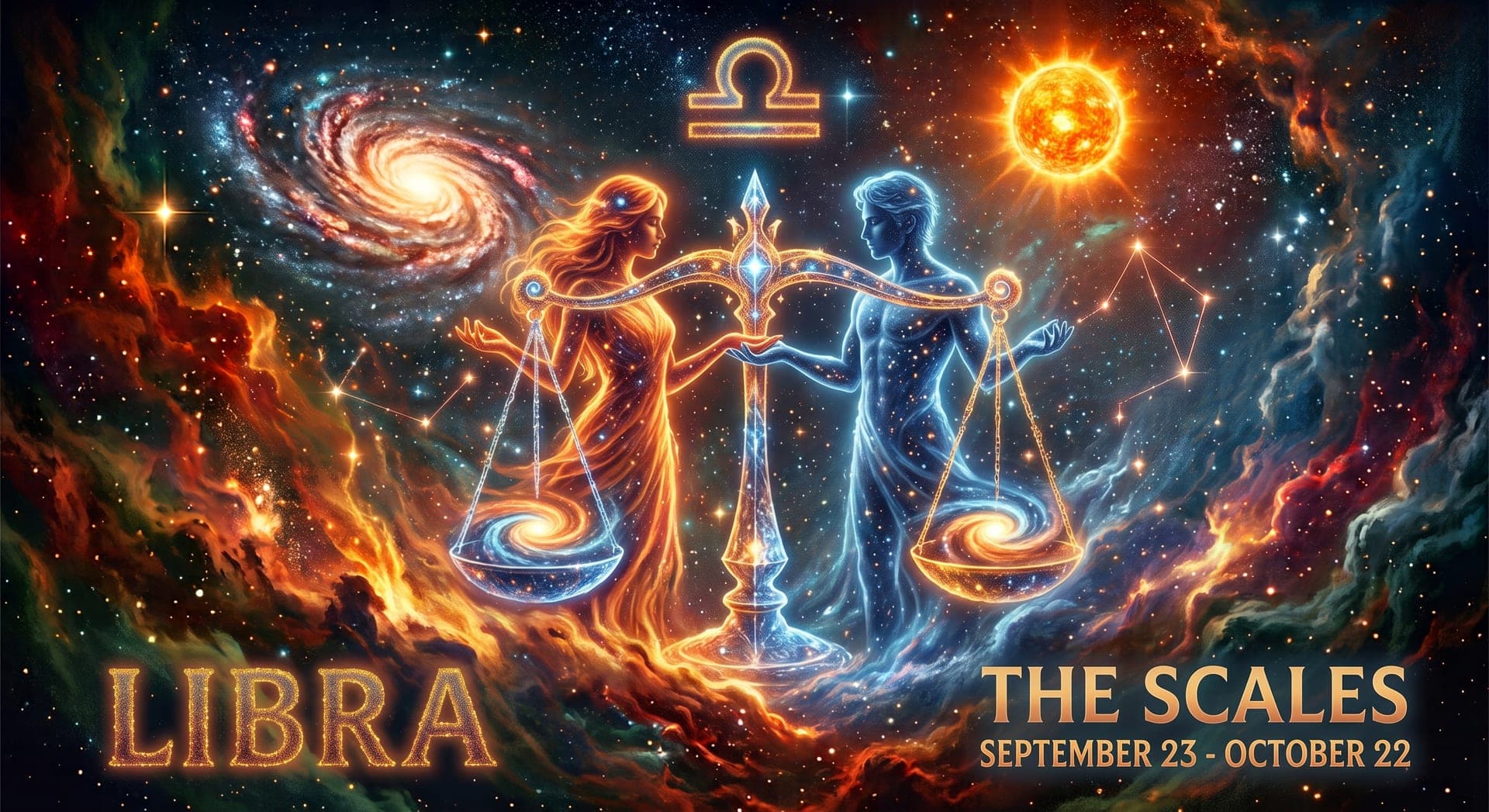
Libra, the seventh sign of the zodiac, spans September 23 to October 22 and is symbolized by the scales, the only zodiac symbol representing an inanimate object rather than a living creature, reflecting the sign's deep concern with balance, fairness, and justice. Ruled by Venus, the planet of love and beauty, Libra shares Taurus's appreciation for aesthetics and pleasure but channels it primarily through relationships, partnership, and social harmony. As an Air sign, Libra approaches the world intellectually and socially, valuing thoughtful conversation and diplomatic problem-solving over confrontation. Its Cardinal modality places it at the very start of autumn, beginning right at the equinox when day and night briefly achieve perfect balance. People born under this sign are often natural mediators, drawn to fairness and equilibrium in their relationships and surroundings, sometimes to the point of struggling to make decisions that might upset that balance. Libra's charm, diplomacy, and genuine desire to see all sides of an issue make it a valued friend and partner, even as its conflict-avoidance can occasionally leave real problems unresolved.
Personality Traits
Strengths
- Strong sense of fairness and justice
- Diplomatic peacemaker
- Charming and sociable
- Appreciates beauty and harmony
- Excellent at seeing multiple perspectives
Weaknesses
- Notoriously indecisive
- Conflict-avoidant to a fault
- Can be superficial
- People-pleasing tendencies
- Struggles with confrontation
Compatible Signs
Fun Facts
- Libra is the only zodiac sign represented by an inanimate object, the scales, rather than an animal or person.
- Libra's scales symbolize balance and justice, echoing the sign's association with fairness, harmony, and diplomacy.
- Venus, Libra's ruling planet, gives the sign its love of beauty, art, and romantic partnership, similar to Taurus but expressed through relationships rather than material comfort.
- As a Cardinal sign, Libra initiates autumn, beginning at the September equinox, when day and night are of equal length, fitting for a sign obsessed with balance.
- Notable Libras include Mahatma Gandhi, Kim Kardashian, John Lennon, and Will Smith.
Born on October 16
- 1803
Robert Stephenson
English civil and railway engineer who designed pioneering bridges and locomotives, building on his father George Stephenson's railway innovations.
- 1854
Oscar Wilde
Irish playwright and novelist
- 1863
Austen Chamberlain
English statesman and Chancellor of the Exchequer who won the Nobel Peace Prize for negotiating the Locarno Pact.
- 1886
David Ben-Gurion
First Prime Minister of Israel
- 1888
Eugene O'Neill
American playwright and Nobel laureate
- 1890
Michael Collins
Irish revolutionary leader
- 1923
Bill McLaren
Scottish rugby union commentator whose distinctive voice and phrases made him one of the most beloved broadcasters in the sport's history.
- 1925
Angela Lansbury
English-American actress
- 1927
Gunter Grass
German novelist and Nobel laureate
- 1930
John Polkinghorne
English particle physicist who left academia for the priesthood and became a leading voice reconciling science and Christian theology.
- 1947
Terry Griffiths
Welsh snooker player who won the World Championship in 1979 on his professional debut and later became a respected coach and commentator.
- 1959
Gary Kemp
English singer-songwriter and guitarist best known as the principal songwriter of the band Spandau Ballet.
- 1977
John Mayer
American singer-songwriter and guitarist
- 1989
Dan Biggar
Welsh rugby union fly-half who represented Wales and the British and Irish Lions at outside-half.
- 1997
Naomi Osaka
Japanese tennis champion
On This Day in History
- 690
Wu Zetian ascends the Tang dynasty throne and proclaims herself sole ruler of the Chinese Empire, its only female emperor.
Wu Zetian, who had wielded effective power as empress dowager and regent for years, formally deposed her own son and declared herself emperor, founding the short-lived Zhou dynasty and becoming the only woman in Chinese history to rule in her own right under the formal title of emperor rather than empress consort.
- 1384
Jadwiga is crowned monarch of Poland despite her gender, ruling as "king" rather than queen.
Jadwiga, daughter of the King of Hungary and Poland, was crowned using the title "king" rather than queen to emphasize her sovereign authority in her own right, later marrying the Grand Duke of Lithuania in a union that began a centuries-long Polish-Lithuanian political partnership.
- 1793
Queen Marie Antoinette is executed by guillotine during the French Revolution.
Following a hasty trial before a revolutionary tribunal, Marie Antoinette was executed by guillotine in Paris's Place de la Revolution, her death coming just months after that of her husband Louis XVI, and it remains one of the most enduringly infamous executions of the French Revolution's Reign of Terror.
- 1793
Former French queen Marie Antoinette is executed by guillotine in Paris during the Reign of Terror.
Convicted of treason by a revolutionary tribunal the previous day, the widow of Louis XVI was taken through the streets of Paris to the Place de la Révolution and beheaded before a crowd. Her death, following her husband's execution earlier that year, became one of the most symbolically charged moments of the French Revolution and cemented her lasting image as a martyr of the old monarchy.
- 1805
Napoleon surrounds and forces the surrender of Austrian forces at Ulm during the War of the Third Coalition.
Napoleon's forces skillfully maneuvered to encircle a substantial Austrian army near the city of Ulm, forcing its surrender with minimal fighting and demonstrating Napoleon's exceptional strategic capability at coordinating rapid troop movements across difficult terrain during the War of the Third Coalition.
- 1813
The four-day Battle of Leipzig begins as the Sixth Coalition attacks Napoleon's forces.
One of the largest battles in European history before the twentieth century began near Leipzig, Germany, as a coalition including Russia, Prussia, Austria, and Sweden confronted Napoleon's forces over four days of intense fighting, ultimately resulting in a decisive coalition victory that forced Napoleon's retreat back toward France.
- 1813
The Battle of Leipzig begins, pitting Napoleon's army against the combined forces of Austria, Prussia, Russia, and Sweden.
Fought over four days near the German city, it became the largest battle in Europe prior to the First World War, involving roughly half a million soldiers. The coalition's decisive victory, often called the Battle of the Nations, shattered Napoleon's control of Germany and forced his retreat toward France, setting the stage for his eventual abdication the following year.
- 1834
Much of the ancient Palace of Westminster in London burns to the ground in a devastating fire.
A catastrophic fire, sparked accidentally while burning obsolete wooden tally sticks used in the treasury, destroyed most of the medieval Palace of Westminster, necessitating the construction of the current Gothic Revival parliamentary buildings recognized today as an iconic symbol of British democracy.
- 1834
A catastrophic fire destroys most of the old Palace of Westminster, the historic seat of the British Parliament, in London.
The blaze began after workmen burning obsolete wooden tally sticks in the House of Lords' furnaces overheated the flues, igniting the ancient timber-framed building. Flames engulfed most of the medieval palace overnight, watched by huge crowds along the Thames, though Westminster Hall was saved. The disaster led to the construction of the current Gothic Revival Houses of Parliament over the following decades.
- 1859
Abolitionist John Brown leads his raid on the federal arsenal at Harpers Ferry, Virginia.
Radical abolitionist John Brown led a small armed group in seizing the federal arsenal at Harpers Ferry, intending to spark a wider slave uprising, though the raid was quickly suppressed by federal troops and Brown was captured, tried, and executed, his actions significantly heightening sectional tensions ahead of the Civil War.
- 1859
Abolitionist John Brown leads a raid on the federal armory at Harpers Ferry, Virginia, hoping to spark a slave uprising.
Brown and a small band of followers seized the arsenal in an attempt to arm enslaved people for a rebellion against the South's slave system. The raid was quickly crushed by local militia and U.S. Marines led by Robert E. Lee, and Brown was captured, tried, and hanged weeks later. The episode inflamed sectional tensions and is often cited as a catalyst on the road to the American Civil War.
- 1869
Girton College, the first English institution to offer women degree-level education at Cambridge, is founded near Hitchin.
Established through the efforts of reformers Emily Davies and Barbara Bodichon, Girton opened at Benslow House in Hitchin at a time when women were barred from full membership of British universities. It moved to its permanent home in the village of Girton, near Cambridge, in 1873, and its students sat the same examinations as men, though the university did not grant women full degrees until 1948.
- 1905
The British colonial government partitions the province of Bengal, splitting it along largely religious lines.
Ordered by Viceroy Lord Curzon, the partition separated a Muslim-majority eastern Bengal from a Hindu-majority west, officially to ease administration of the vast province. Many Indians viewed it as a deliberate British attempt to weaken a growing nationalist movement by dividing communities. The backlash fueled mass protests and boycotts, and the partition was ultimately reversed in 1911.
- 1923
Walt Disney and his brother Roy establish the Disney Brothers Cartoon Studio.
Walt and Roy Disney formally established their animation studio in Los Angeles with a modest initial contract to produce a series of cartoon shorts, a modest beginning that grew over subsequent decades into one of the world's largest and most influential entertainment conglomerates.
- 1939
Royal Air Force Spitfires shoot down German bombers attacking Royal Navy ships at the Firth of Forth in Scotland, in the first Luftwaffe raid on Britain of the Second World War.
Twelve German Junkers Ju 88s targeted warships anchored near the Forth Bridge, believing they had located the battlecruiser HMS Hood, though they actually struck HMS Repulse and other vessels. Spitfires of 602 and 603 Squadrons intercepted the raiders, shooting down two bombers and damaging a third. It was the first enemy aircraft destroyed over Britain in the war, months ahead of the far larger Battle of Britain.
- 1978
Karol Wojtyla becomes Pope John Paul II, the first non-Italian pontiff in over four centuries.
Polish Cardinal Karol Wojtyla was elected pope, taking the name John Paul II and becoming the first non-Italian pontiff since the sixteenth century, going on to serve one of the longest papacies in history and playing a significant role in the eventual collapse of Communist rule in his native Poland and across Eastern Europe.
- 1995
The Skye Bridge opens, providing the first road link between the Isle of Skye and mainland Scotland.
Replacing the traditional ferry crossing at Kyle of Lochalsh, the bridge shortened journey times to the island considerably. Its introduction proved controversial because of the tolls charged to cross, which sparked years of protest and a campaign of civil disobedience by islanders. The tolls were eventually abolished by the Scottish Executive in 2004.
- 1998
Former Chilean dictator Augusto Pinochet is arrested in London on a Spanish warrant while receiving medical treatment.
British police detained the 82-year-old former general at the request of a Spanish judge investigating deaths and torture of Spanish citizens during his rule. The arrest triggered a landmark legal battle in the British courts over whether a former head of state could claim immunity from prosecution abroad. Pinochet was eventually released on health grounds in 2000 rather than extradited to Spain.
- 2002
The Bibliotheca Alexandrina opens in Egypt, commemorating the ancient Library of Alexandria.
A modern library built near the site of the legendary ancient Library of Alexandria, once among history's greatest repositories of knowledge before its destruction in antiquity, opened in Egypt as both a functioning research institution and a symbolic tribute to the pursuit of learning across cultures.
- 2017
Storm Ophelia batters the United Kingdom and Ireland with hurricane-force winds, causing major damage and power outages.
Originally a major Atlantic hurricane, Ophelia weakened as it curved toward Western Europe but still brought destructive winds, downed trees, and widespread power cuts across Ireland and parts of Britain. Saharan dust and smoke swept up in the storm's circulation gave skies an eerie orange tint over southern England. The storm caused several deaths and was one of the most damaging to hit Ireland in decades.