
What’s Observed on October 15
Born on October 15: Libra ♎
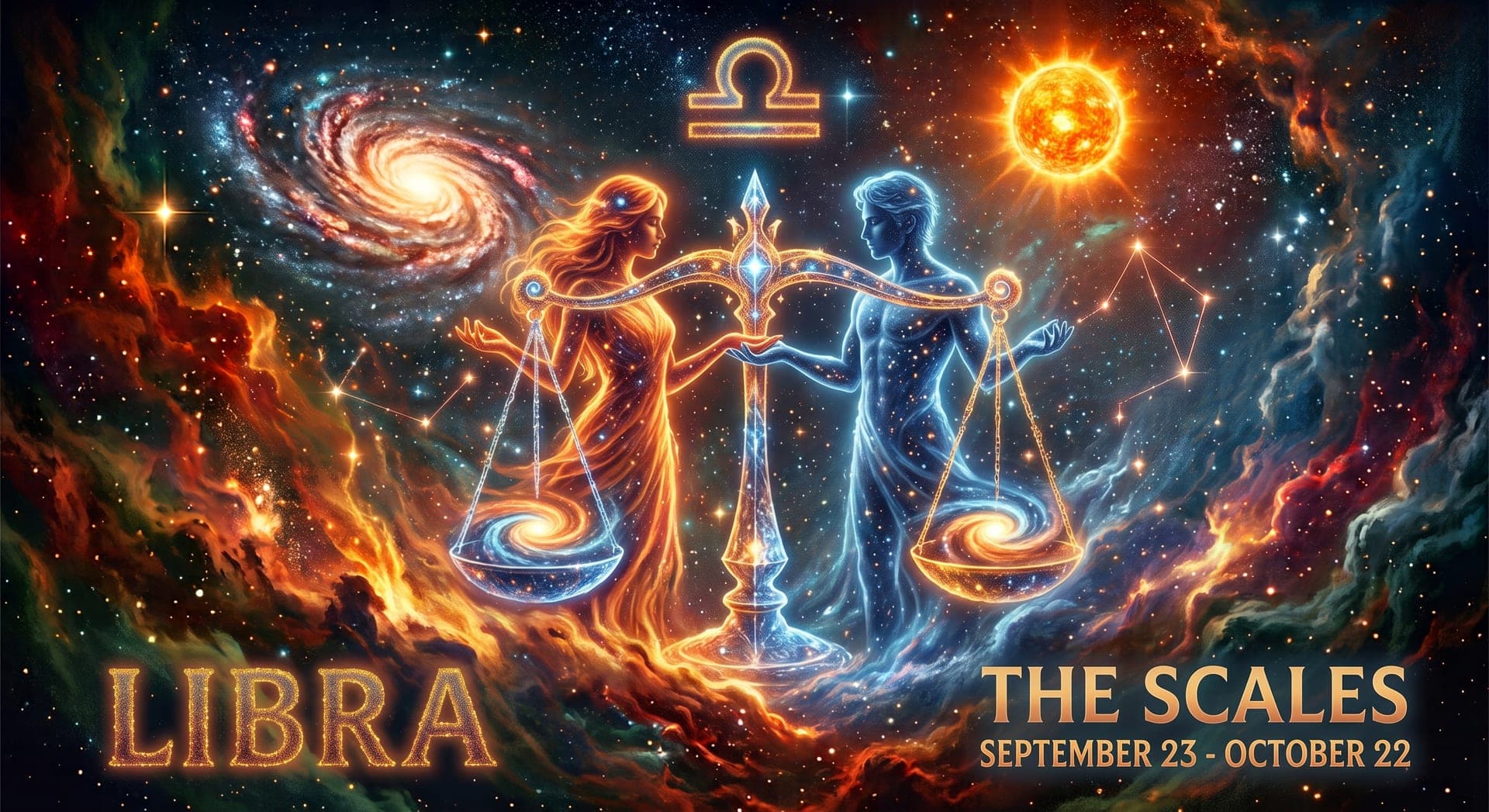
Libra, the seventh sign of the zodiac, spans September 23 to October 22 and is symbolized by the scales, the only zodiac symbol representing an inanimate object rather than a living creature, reflecting the sign's deep concern with balance, fairness, and justice. Ruled by Venus, the planet of love and beauty, Libra shares Taurus's appreciation for aesthetics and pleasure but channels it primarily through relationships, partnership, and social harmony. As an Air sign, Libra approaches the world intellectually and socially, valuing thoughtful conversation and diplomatic problem-solving over confrontation. Its Cardinal modality places it at the very start of autumn, beginning right at the equinox when day and night briefly achieve perfect balance. People born under this sign are often natural mediators, drawn to fairness and equilibrium in their relationships and surroundings, sometimes to the point of struggling to make decisions that might upset that balance. Libra's charm, diplomacy, and genuine desire to see all sides of an issue make it a valued friend and partner, even as its conflict-avoidance can occasionally leave real problems unresolved.
Personality Traits
Strengths
- Strong sense of fairness and justice
- Diplomatic peacemaker
- Charming and sociable
- Appreciates beauty and harmony
- Excellent at seeing multiple perspectives
Weaknesses
- Notoriously indecisive
- Conflict-avoidant to a fault
- Can be superficial
- People-pleasing tendencies
- Struggles with confrontation
Compatible Signs
Fun Facts
- Libra is the only zodiac sign represented by an inanimate object, the scales, rather than an animal or person.
- Libra's scales symbolize balance and justice, echoing the sign's association with fairness, harmony, and diplomacy.
- Venus, Libra's ruling planet, gives the sign its love of beauty, art, and romantic partnership, similar to Taurus but expressed through relationships rather than material comfort.
- As a Cardinal sign, Libra initiates autumn, beginning at the September equinox, when day and night are of equal length, fitting for a sign obsessed with balance.
- Notable Libras include Mahatma Gandhi, Kim Kardashian, John Lennon, and Will Smith.
Born on October 15
- 1542
Akbar
Mughal emperor of India
- 1686
Allan Ramsay
Scottish poet and playwright celebrated for reviving vernacular Scots poetry and for founding one of Britain's first circulating libraries in Edinburgh.
- 1814
Mikhail Lermontov
Russian poet and novelist
- 1844
Friedrich Nietzsche
German philosopher
- 1881
P. G. Wodehouse
English novelist and humorist best known for creating Jeeves and Wooster, among the most enduring comic characters in English literature.
- 1887
Frederick Fleet
English sailor who, as lookout aboard the RMS Titanic, was the first to spot the iceberg that sank the ship.
- 1923
Italo Calvino
Italian novelist
- 1925
Tony Hart
English artist and television presenter who introduced generations of children to drawing and art through long-running BBC programmes.
- 1926
Michel Foucault
French philosopher and historian
- 1944
David Trimble
Northern Irish politician and First Minister of Northern Ireland who shared the Nobel Peace Prize for his role in the Good Friday Agreement.
- 1959
Emeril Lagasse
American chef
- 1959
Sarah, Duchess of York
English royal, author, and television personality who was married to Prince Andrew, Duke of York.
- 1989
Anthony Joshua
English professional boxer and former unified heavyweight world champion, and an Olympic gold medalist.

On This Day in History
- 1066
Following King Harold II's death at Hastings, Edgar the Aetheling is proclaimed King of England by the Witan council.
Following King Harold II's death at the Battle of Hastings the previous day, England's council of nobles and clergy proclaimed the young Edgar the Aetheling, a descendant of the pre-Norman royal line, as king, though his brief and largely symbolic reign ended within weeks as William the Conqueror's forces secured control of the country.
- 1066
Following King Harold II's death at Hastings, the young nobleman Edgar the Ætheling is proclaimed King of England by the Witan.
Edgar, a great-nephew of Edward the Confessor, was chosen by the English council as a rallying point after Harold's defeat and death at the Battle of Hastings. He was never crowned, and with London and the south under threat from William of Normandy's advancing army, English resistance collapsed. Edgar submitted to William two months later, ending any serious challenge to the Norman Conquest.
- 1529
Austrian forces successfully repel the first Ottoman siege of Vienna, halting Ottoman expansion into Central Europe.
After weeks of siege by a massive Ottoman army under Suleiman the Magnificent, Austrian defenders successfully repelled the assault as harsh weather and supply difficulties forced an Ottoman withdrawal, a defensive victory widely regarded as marking the high-water mark of Ottoman expansion into Central Europe.
- 1529
The Ottoman siege of Vienna ends as Suleiman the Magnificent's forces withdraw, halting the Ottoman advance into Central Europe.
After weeks of fighting outside the Austrian capital, the onset of harsh weather, supply shortages, and stiff Habsburg defense forced the Ottoman army to retreat. The failed siege marked the limit of Ottoman expansion into Western Europe and set the stage for over a century of continued conflict between the Habsburg and Ottoman empires along the Danube.
- 1651
Qing forces capture Zhoushan Island, forcing the Ming loyalist regent to flee to Kinmen.
Following the collapse of Ming loyalist resistance on the Chinese mainland, Qing forces captured the strategic island of Zhoushan, forcing the remaining Ming loyalist court under the Prince of Lu to retreat further to the offshore island of Kinmen, part of the broader Qing consolidation of control following the Ming dynasty's collapse.
- 1783
The Montgolfier brothers' hot air balloon achieves the first human ascent, piloted by Jean-Francois Pilatre de Rozier.
Physicist Jean-Francois Pilatre de Rozier became the first human to ascend into the air aboard a hot air balloon, tethered to the ground during this initial test flight in Paris, a milestone that preceded the Montgolfier brothers' first untethered free flight carrying human passengers just weeks later.
- 1783
Jean-François Pilâtre de Rozier makes the first human ascent in a hot air balloon, designed by the Montgolfier brothers.
Tethered above Paris, the flight demonstrated that a person could safely rise into the air aboard a hot-air balloon, building on earlier unmanned and animal test flights. The achievement paved the way for the first free, untethered balloon flight weeks later and launched the age of human flight, decades before powered aircraft existed.
- 1793
Queen Marie Antoinette of France is tried and convicted of treason by a revolutionary tribunal.
Following her husband's execution nine months earlier, Queen Marie Antoinette faced a revolutionary tribunal on charges including treason and, in a particularly cruel accusation, incestuous abuse of her young son, charges widely regarded by historians as fabricated propaganda intended to thoroughly discredit the deposed monarchy before her execution.
- 1793
Queen Marie Antoinette is tried by a French revolutionary tribunal and convicted of treason.
Widowed by her husband Louis XVI's execution earlier that year, Marie Antoinette faced a hastily assembled tribunal on charges including treason and conspiracy against the republic. The trial, widely regarded as a formality with a predetermined outcome, ended in a swift guilty verdict. She was guillotined the following day, becoming one of the French Revolution's most enduring symbols.
- 1815
Napoleon Bonaparte begins his final exile on the remote island of Saint Helena.
Following his final defeat at Waterloo, Napoleon Bonaparte arrived at the remote South Atlantic island of Saint Helena, where British authorities confined him under close guard for the remainder of his life, ensuring he could never again escape exile and threaten European stability as he had after his first banishment to Elba.
- 1815
Napoleon Bonaparte begins his final exile on the British-held island of Saint Helena in the South Atlantic.
After his defeat at Waterloo and surrender to the Royal Navy, Napoleon was transported by the British to the remote island, chosen for its isolation to prevent any further escape or return to power. He lived there under British guard for nearly six years, watched closely by a garrison and governor appointed by London, until his death in 1821.
- 1888
The so-called "From Hell" letter, allegedly from Jack the Ripper, is received by London investigators.
A letter purportedly written by the unidentified serial killer terrorizing London's Whitechapel district, accompanied by a preserved portion of a human kidney, was sent to a local vigilance committee, though its authenticity, like much surrounding the Jack the Ripper case, remains disputed by historians and criminologists.
- 1888
British investigators receive the infamous "From Hell" letter, purportedly written by the unidentified serial killer Jack the Ripper.
The letter, accompanied by a portion of a preserved human kidney, was sent to George Lusk, head of a Whitechapel vigilance committee formed during the murders. Its authenticity has never been confirmed, and it remains one of several disputed communications attributed to the killer. The unsolved Whitechapel murders continue to be one of the most notorious cases in London's criminal history.
- 1928
The airship Graf Zeppelin completes its first transatlantic flight, arriving in New Jersey from Germany.
The rigid airship carried passengers and crew across the Atlantic in roughly four and a half days, overcoming a torn fin during the journey. Its safe arrival demonstrated the practicality of long-distance airship travel and boosted public confidence in Zeppelin transport, which briefly flourished as a luxury means of crossing oceans before the era of passenger airliners.
- 1954
Hurricane Hazel strikes the eastern United States and Canada, killing around 95 people and causing severe flooding.
After first devastating parts of the Caribbean, Hazel made landfall on the U.S. East Coast before tracking north into Ontario, where its remnants dumped torrential rain on Toronto. Rivers overflowed catastrophically, sweeping away homes and bridges. The storm remains one of the deadliest and most damaging in Canadian history and reshaped floodplain policy in the region.
- 1956
FORTRAN, widely regarded as the first modern high-level computer programming language, is shared with the coding community.
IBM began distributing FORTRAN, a programming language designed by John Backus and his team to allow scientists and engineers to write computer instructions using mathematical formulas rather than tedious machine code, dramatically simplifying scientific computing and establishing programming conventions still influential in modern computer science.
- 1990
Soviet leader Mikhail Gorbachev is awarded the Nobel Peace Prize for his role in easing Cold War tensions.
The prize recognized Gorbachev's reforms of glasnost and perestroika and his part in the withdrawal of Soviet troops from Eastern Europe, contributing to the end of the Cold War. The award came amid growing turmoil within the Soviet Union itself, which would dissolve just over a year later. Gorbachev remains a polarizing figure, celebrated abroad but often blamed at home for the Soviet collapse.
- 1997
NASA launches the Cassini spacecraft on a mission to study Saturn and its moons.
Built jointly with the European and Italian space agencies, Cassini carried the Huygens probe, designed to land on Saturn's moon Titan. After a seven-year journey using gravity assists from Venus, Earth, and Jupiter, it entered orbit around Saturn in 2004. The mission revolutionized understanding of the ringed planet before being deliberately deorbited into its atmosphere in 2017.
- 2003
China launches Shenzhou 5, achieving its first crewed spaceflight mission.
China became the third nation to independently launch a human into orbit when astronaut Yang Liwei completed a 21-hour mission aboard Shenzhou 5, a major milestone for China's space program that has since expanded to include a permanent space station and ambitious lunar exploration plans.
- 2013
A 7.2 magnitude earthquake strikes the Philippines' Bohol region, killing over 215 people.
A powerful earthquake struck the Bohol and Cebu provinces of the Philippines, collapsing numerous historic churches and other structures across the region and killing over 215 people, prompting significant reconstruction and heritage restoration efforts for the area's centuries-old Spanish colonial architecture.