What’s Observed on October 14
Born on October 14: Libra ♎
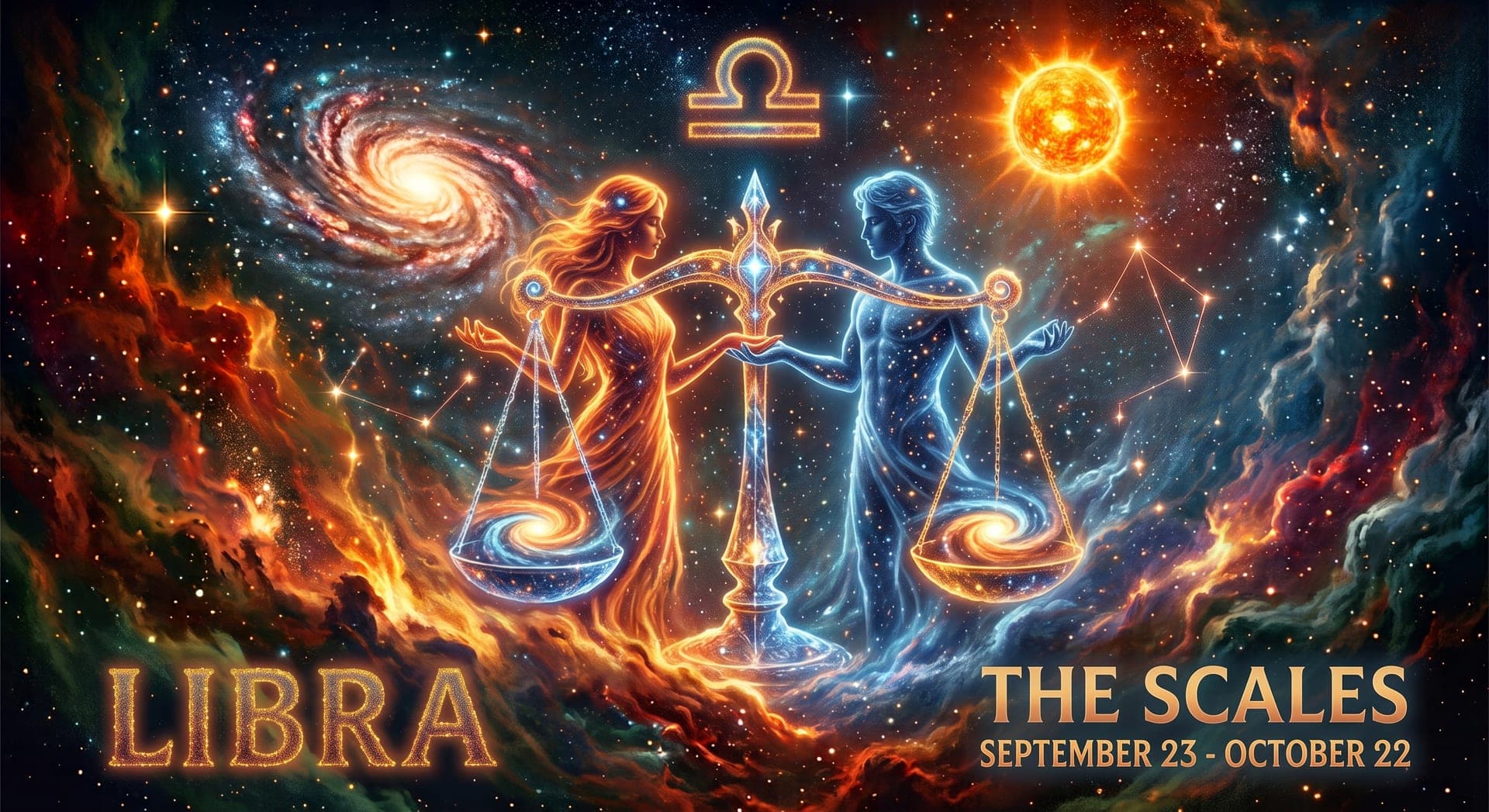
Libra, the seventh sign of the zodiac, spans September 23 to October 22 and is symbolized by the scales, the only zodiac symbol representing an inanimate object rather than a living creature, reflecting the sign's deep concern with balance, fairness, and justice. Ruled by Venus, the planet of love and beauty, Libra shares Taurus's appreciation for aesthetics and pleasure but channels it primarily through relationships, partnership, and social harmony. As an Air sign, Libra approaches the world intellectually and socially, valuing thoughtful conversation and diplomatic problem-solving over confrontation. Its Cardinal modality places it at the very start of autumn, beginning right at the equinox when day and night briefly achieve perfect balance. People born under this sign are often natural mediators, drawn to fairness and equilibrium in their relationships and surroundings, sometimes to the point of struggling to make decisions that might upset that balance. Libra's charm, diplomacy, and genuine desire to see all sides of an issue make it a valued friend and partner, even as its conflict-avoidance can occasionally leave real problems unresolved.
Personality Traits
Strengths
- Strong sense of fairness and justice
- Diplomatic peacemaker
- Charming and sociable
- Appreciates beauty and harmony
- Excellent at seeing multiple perspectives
Weaknesses
- Notoriously indecisive
- Conflict-avoidant to a fault
- Can be superficial
- People-pleasing tendencies
- Struggles with confrontation
Compatible Signs
Fun Facts
- Libra is the only zodiac sign represented by an inanimate object, the scales, rather than an animal or person.
- Libra's scales symbolize balance and justice, echoing the sign's association with fairness, harmony, and diplomacy.
- Venus, Libra's ruling planet, gives the sign its love of beauty, art, and romantic partnership, similar to Taurus but expressed through relationships rather than material comfort.
- As a Cardinal sign, Libra initiates autumn, beginning at the September equinox, when day and night are of equal length, fitting for a sign obsessed with balance.
- Notable Libras include Mahatma Gandhi, Kim Kardashian, John Lennon, and Will Smith.
Born on October 14
- 1633
James II of England
English king who reigned from 1685 until being deposed in the Glorious Revolution of 1688 due to his Catholicism and authoritarian rule.
- 1644
William Penn
English businessman and Quaker leader who founded the American colony of Pennsylvania as a haven for religious tolerance.
- 1687
Robert Simson
Scottish mathematician renowned for his editions of Euclid's Elements and for the geometric result known as the Simson line.
- 1882
Eamon de Valera
President of Ireland
- 1888
Katherine Mansfield
New Zealand short story writer
- 1890
Dwight D. Eisenhower
34th President of the United States
- 1894
E. E. Cummings
American poet
- 1894
Victoria Drummond
Scottish marine engineer, the first woman in Britain to qualify as a chief engineer, who served at sea through two world wars.
- 1927
Roger Moore
English actor best known for playing secret agent James Bond in seven films during the 1970s and 1980s.
- 1939
Ralph Lauren
American fashion designer
- 1940
Cliff Richard
English singer
- 1965
Steve Coogan
English actor and comedian celebrated for creating the character Alan Partridge and for his work in film and television comedy.
- 1978
Usher
American singer and dancer
- 1980
Ben Whishaw
English actor known for playing Q in the James Bond films and for voicing Paddington Bear in the Paddington film series.
On This Day in History
- 1066
The Norman conquest of England begins as William of Normandy defeats King Harold II at the Battle of Hastings.
William, Duke of Normandy, decisively defeated King Harold II's exhausted English army, with Harold reportedly killed by an arrow to the eye, a victory that began the Norman conquest of England and fundamentally transformed English language, culture, law, and aristocracy over the following centuries.
- 1066
The Norman Conquest of England begins as William, Duke of Normandy, defeats King Harold II at the Battle of Hastings.
Duke William of Normandy crossed the Channel and met King Harold II's army near Hastings on the Sussex coast. Harold was killed in the fighting and his forces were routed. The victory opened the way for William's coronation as King of England that Christmas and reshaped English language, law, and aristocracy for centuries to come.
- 1322
Robert the Bruce's Scottish forces rout an English army under King Edward II at the Battle of Old Byland in Yorkshire.
The battle came during a Scottish raid deep into northern England amid ongoing border warfare following Bannockburn. Edward II narrowly escaped capture, fleeing so hastily that his personal baggage was seized. The defeat further weakened Edward's authority in England and pushed the two kingdoms toward eventually recognizing Scottish independence.
- 1586
Mary, Queen of Scots, begins her trial for alleged conspiracy against Queen Elizabeth I.
Mary, Queen of Scots, held under house arrest in England for years due to her rival claim to the English throne, went on trial before a specially convened commission after letters implicating her in a plot to assassinate Elizabeth I were intercepted, a trial that culminated in her execution the following February.
- 1586
Mary, Queen of Scots goes on trial at Fotheringhay Castle for conspiring to assassinate Queen Elizabeth I.
Implicated by intercepted letters in the Babington Plot, Mary was tried before a commission of English noblemen despite her status as an anointed queen. She denied any role in the conspiracy, but the evidence proved damning. Found guilty, she was executed the following February, removing a Catholic rival to Elizabeth's throne.
- 1774
The First Continental Congress denounces Britain's "Intolerable Acts" and demands concessions.
Delegates to the First Continental Congress adopted a formal declaration condemning the punitive British laws passed in response to the Boston Tea Party, asserting colonial rights while still stopping short of calling for full independence, representing an important step in unifying colonial resistance to British policy.
- 1791
The Society of United Irishmen is founded in Belfast, seeking parliamentary reform and an end to religious discrimination.
Inspired by the French and American revolutions, the group initially brought together Protestants and Catholics campaigning for a fairer, non-sectarian Irish parliament. It later turned toward outright republicanism and armed rebellion, culminating in the failed uprising of 1798 and leaving a lasting influence on Irish nationalist politics for generations.
- 1806
Napoleon achieves a decisive victory over Prussian forces at the Battle of Jena-Auerstedt.
Napoleon's forces achieved a crushing simultaneous victory over Prussian armies at the twin battles of Jena and Auerstedt, effectively destroying Prussia's military reputation and leading to the rapid occupation of Berlin, a humiliation that later spurred significant Prussian military and administrative reforms.
- 1843
Irish political leader Daniel O'Connell is arrested by British authorities on charges of conspiracy.
O'Connell, who had campaigned successfully for Catholic emancipation, was leading a mass movement to repeal the Act of Union between Great Britain and Ireland. After a huge rally at Clontarf was banned, authorities charged him with conspiracy against the state. He was convicted, though the sentence was later overturned, and the episode blunted the momentum of his repeal campaign.
- 1884
George Eastman obtains a U.S. patent for his innovative paper-strip photographic film.
Inventor George Eastman secured a patent for flexible roll film using a paper backing, a critical innovation that eliminated the need for cumbersome glass photographic plates and laid essential groundwork for accessible amateur photography, later refined further with the introduction of celluloid film.
- 1888
Louis Le Prince films "Roundhay Garden Scene," widely regarded as the earliest surviving motion picture.
French inventor Louis Le Prince filmed a brief sequence of family members walking in a garden using his early motion picture camera, a recording now recognized by many film historians as the oldest surviving motion picture footage, though Le Prince mysteriously vanished before he could publicly demonstrate or patent his invention.
- 1888
Frenchman Louis Le Prince films Roundhay Garden Scene in Leeds, widely regarded as the oldest surviving motion picture.
Working in England, Le Prince used his single-lens camera to capture just over a second and a half of moving footage of his family in a Leeds garden. The brief film predates the public demonstrations of Edison and the Lumière brothers by several years. Le Prince mysteriously vanished less than two years later, leaving his pioneering role in cinema history often overlooked.
- 1898
The passenger steamship SS Mohegan runs aground and sinks off the Cornish coast, killing 106 people.
Bound for New York, the Atlantic Transport Line steamer inexplicably veered off course and struck the Manacles rocks near Falmouth in calm conditions. It sank within minutes, giving passengers little chance to escape. Of the 157 people aboard, 51 were rescued by lifeboat and other boats while 106 drowned, and questions about the ship's navigation were never fully resolved.
- 1913
An explosion at the Senghenydd colliery in Wales kills 439 miners, the worst mining disaster in British history.
A build-up of firedamp ignited deep underground at the Universal Colliery near Caerphilly, triggering a catastrophic explosion and fire. Most of the dead were trapped by the blast or overcome by afterdamp before rescuers could reach them. The tragedy, still the deadliest coal mining accident the United Kingdom has ever seen, led to tighter safety regulations in British pits.
- 1939
German submarine U-47 penetrates the Royal Navy anchorage at Scapa Flow and sinks the battleship HMS Royal Oak.
Under Commander Günther Prien, U-47 slipped through narrow defenses into the Orkney Islands base under cover of darkness and torpedoed the anchored battleship. Royal Oak sank within minutes, killing 835 of her 1,234 crew, many of them boy sailors. The raid shocked Britain, exposed serious gaps in Scapa Flow's defenses, and led to a major strengthening of the base.
- 1940
A German bomb breaches the road above Balham Underground station in London, killing 66 people sheltering below.
During the height of the Blitz, a high-explosive bomb struck the road directly above the station, collapsing the tunnel roof and flooding the shelter with water, earth, and debris from a burst water main. Dozens of Londoners who had taken refuge on the platforms were killed. The disaster became one of the most infamous tragedies of the London Underground's wartime use as an air-raid shelter.
- 1947
Chuck Yeager becomes the first pilot to break the sound barrier in level flight.
Test pilot Chuck Yeager flew the Bell X-1 rocket-powered aircraft faster than the speed of sound over California's Mojave Desert, achieving a milestone many aviation experts had previously believed physically impossible or fatally dangerous, opening the door to the subsequent development of supersonic military and later commercial aircraft.
- 1962
American reconnaissance aircraft detect Soviet ballistic missiles in Cuba, beginning the Cuban Missile Crisis.
A U.S. Air Force reconnaissance flight over Cuba captured photographic evidence of Soviet medium-range ballistic missile installations under construction, triggering a tense thirteen-day standoff between the United States and Soviet Union that brought the world closer to nuclear war than at any other point during the Cold War.
- 1964
Martin Luther King Jr. is awarded the Nobel Peace Prize for his leadership of the nonviolent civil rights movement.
At just 35 years old, Martin Luther King Jr. became the youngest recipient of the Nobel Peace Prize at the time, honored for his leadership of the nonviolent American civil rights movement, and he donated the entirety of the prize money to further the ongoing struggle for racial equality.
- 2012
Felix Baumgartner completes a record-setting stratospheric skydive, breaking the sound barrier during freefall.
Austrian skydiver Felix Baumgartner ascended nearly 24 miles above Earth in a helium balloon before jumping, becoming the first skydiver to break the sound barrier during freefall and setting multiple records for the highest and fastest human freefall in a mission sponsored by an energy drink company and closely monitored for safety.