What’s Observed on October 13
Born on October 13: Libra ♎
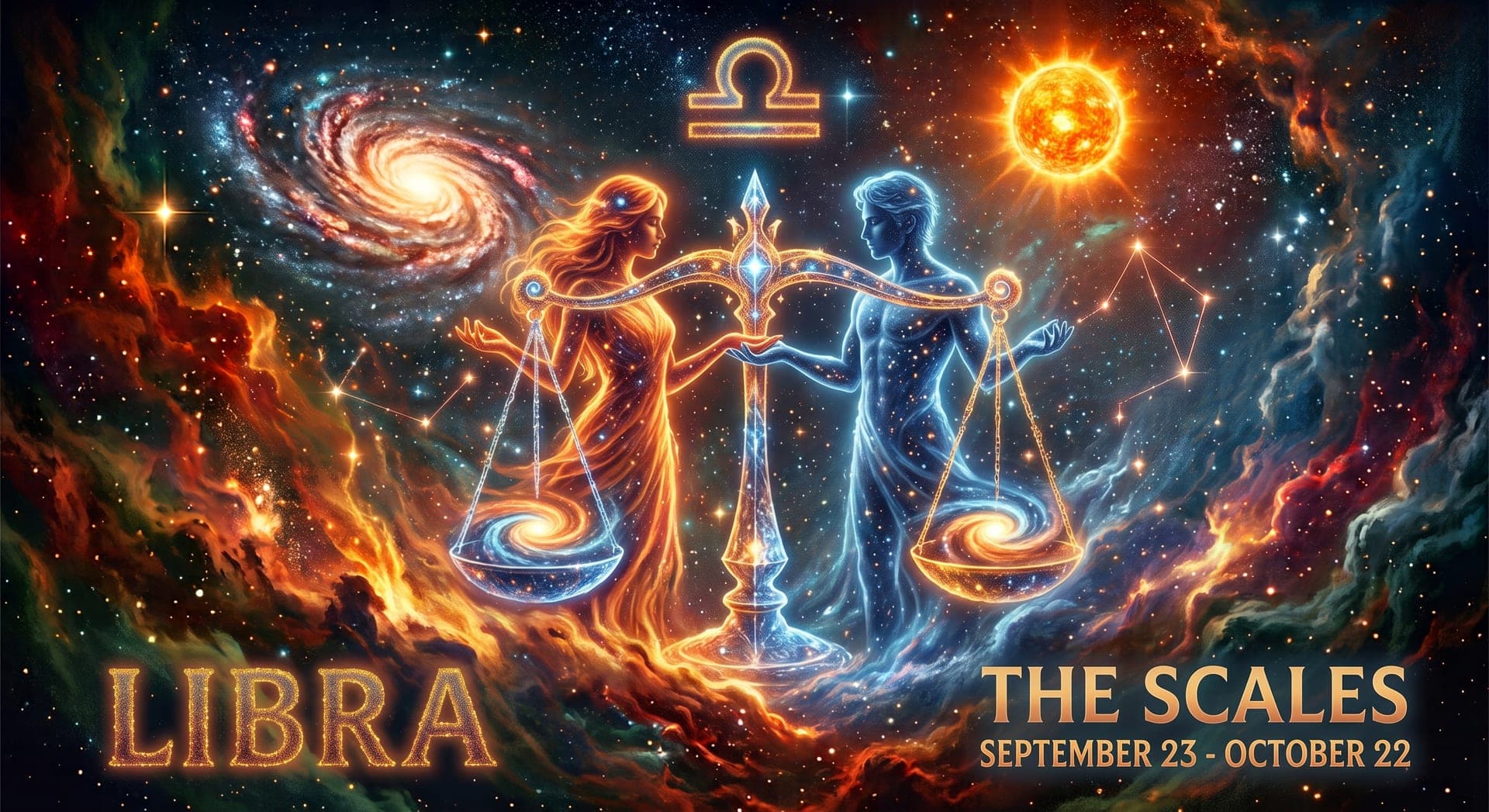
Libra, the seventh sign of the zodiac, spans September 23 to October 22 and is symbolized by the scales, the only zodiac symbol representing an inanimate object rather than a living creature, reflecting the sign's deep concern with balance, fairness, and justice. Ruled by Venus, the planet of love and beauty, Libra shares Taurus's appreciation for aesthetics and pleasure but channels it primarily through relationships, partnership, and social harmony. As an Air sign, Libra approaches the world intellectually and socially, valuing thoughtful conversation and diplomatic problem-solving over confrontation. Its Cardinal modality places it at the very start of autumn, beginning right at the equinox when day and night briefly achieve perfect balance. People born under this sign are often natural mediators, drawn to fairness and equilibrium in their relationships and surroundings, sometimes to the point of struggling to make decisions that might upset that balance. Libra's charm, diplomacy, and genuine desire to see all sides of an issue make it a valued friend and partner, even as its conflict-avoidance can occasionally leave real problems unresolved.
Personality Traits
Strengths
- Strong sense of fairness and justice
- Diplomatic peacemaker
- Charming and sociable
- Appreciates beauty and harmony
- Excellent at seeing multiple perspectives
Weaknesses
- Notoriously indecisive
- Conflict-avoidant to a fault
- Can be superficial
- People-pleasing tendencies
- Struggles with confrontation
Compatible Signs
Fun Facts
- Libra is the only zodiac sign represented by an inanimate object, the scales, rather than an animal or person.
- Libra's scales symbolize balance and justice, echoing the sign's association with fairness, harmony, and diplomacy.
- Venus, Libra's ruling planet, gives the sign its love of beauty, art, and romantic partnership, similar to Taurus but expressed through relationships rather than material comfort.
- As a Cardinal sign, Libra initiates autumn, beginning at the September equinox, when day and night are of equal length, fitting for a sign obsessed with balance.
- Notable Libras include Mahatma Gandhi, Kim Kardashian, John Lennon, and Will Smith.
Born on October 13
- 1713
Allan Ramsay
Scottish portrait painter who served as Principal Painter to King George III
- 1862
Mary Kingsley
English explorer and writer whose travels through West Africa produced influential accounts of the region's peoples and natural history
- 1909
Art Tatum
American jazz pianist
- 1921
Yves Montand
Italian-French actor and singer
- 1925
Lenny Bruce
American stand-up comedian
- 1925
Margaret Thatcher
English chemist and Conservative politician who served as Prime Minister of the United Kingdom from 1979 to 1990
- 1941
Paul Simon
American singer-songwriter of Simon & Garfunkel
- 1941
John Snow
English cricketer who was one of the country's leading fast bowlers during the 1960s and 1970s
- 1946
Edwina Currie
English politician and broadcaster who served as a junior health minister under Margaret Thatcher
- 1962
Jerry Rice
American NFL wide receiver
- 1969
Nancy Kerrigan
American figure skater
- 1970
Paul Potts
English tenor who rose to fame after winning the first series of Britain's Got Talent
- 1970
Rob Howley
Welsh rugby union player and coach who captained Wales and later served as the national team's attack coach
- 1971
Sacha Baron Cohen
English comedian and actor known for creating characters including Ali G, Borat, and Bruno
- 1980
Ashanti
American singer and actress
On This Day in History
- 54
Roman Emperor Claudius dies from poisoning under mysterious circumstances and is succeeded by his adopted son, Nero.
Emperor Claudius, whose reign had been marked by significant administrative competence despite his reputation for physical infirmity, died suddenly under circumstances widely believed by ancient historians to involve poisoning orchestrated by his wife Agrippina, who sought to secure the throne for her son Nero over Claudius's own biological son, Britannicus.
- 54
Roman emperor Claudius dies from suspected poisoning, clearing the way for his stepson Nero to succeed him rather than his own son Britannicus.
Claudius, who had overseen the Roman conquest of Britain a decade earlier, was reportedly poisoned by his wife Agrippina the Younger, who sought the throne for her son from a previous marriage. Nero became emperor at just sixteen, sidelining Claudius's biological son Britannicus, who died suspiciously himself within months. Claudius's death marked a pivotal and notoriously turbulent transition in the early Roman Empire.
- 1269
The current Westminster Abbey church building is consecrated in London.
King Henry III's ambitious rebuilding of Westminster Abbey in the Gothic style, intended partly to honor Edward the Confessor and enhance the abbey's role in English royal ceremony, reached completion for its consecration, establishing the essential architectural form of the church still recognized today as the site of English coronations.
- 1269
The present church building of Westminster Abbey is consecrated after King Henry III's extensive rebuilding of the site.
Henry III, a devoted admirer of Edward the Confessor, tore down much of the earlier Norman abbey to build a grand new Gothic church in the confessor's honor, modeled partly on French cathedrals. The rebuilt abbey became the coronation church and burial site for English monarchs for centuries afterward. Its consecration marked the completion of one of the most ambitious architectural projects of medieval England.
- 1307
French King Philip IV orders the arrest of hundreds of Knights Templar at dawn, many later confessing to heresy under torture.
Acting on accusations of heresy, blasphemy, and financial corruption, likely motivated significantly by King Philip IV's substantial debts to the wealthy military order, French authorities arrested hundreds of Knights Templar across the country in a coordinated dawn raid, with many confessing under brutal torture to charges historians now widely regard as largely fabricated.
- 1307
King Philip IV of France orders the mass arrest of Knights Templar across the country on charges of heresy.
Philip, deeply in debt to the wealthy military order, moved simultaneously against Templar houses throughout France, and many members were tortured into confessing to fabricated charges including idolatry and blasphemy. The crackdown led Pope Clement V to dissolve the order entirely in 1312. The Templars' sudden downfall, after two centuries as a powerful military and financial institution, became one of the most notorious episodes of the medieval Church.
- 1399
Henry IV of England is crowned at Westminster Abbey following his seizure of the throne.
Henry Bolingbroke, who had recently deposed his cousin Richard II, was crowned King Henry IV of England, founding the Lancastrian royal line whose contested legitimacy later contributed significantly to the prolonged dynastic conflict known as the Wars of the Roses.
- 1399
Henry IV is crowned King of England at Westminster Abbey after deposing his cousin Richard II.
Henry, formerly the Duke of Lancaster, had returned from exile to seize the throne after Richard II confiscated his inheritance and alienated much of the nobility. His coronation established the House of Lancaster's hold on the English crown, though the questionable legitimacy of his usurpation fueled decades of unrest, including rebellions and the eventual dynastic conflict known as the Wars of the Roses.
- 1710
British forces successfully besiege Port Royal, capturing the capital of French Acadia.
British forces captured Port Royal, the capital of French Acadia, during Queen Anne's War, a conquest later formalized through the Treaty of Utrecht that transferred Acadia to permanent British control, setting the stage for the eventual mass deportation of Acadian settlers decades later.
- 1710
Port Royal, the capital of French Acadia, falls to a British siege, giving Britain control of mainland Nova Scotia.
A force of British regulars and New England colonial troops besieged the small French garrison during Queen Anne's War, part of the broader War of the Spanish Succession. Following its capture, the town was renamed Annapolis Royal in honor of Queen Anne. The conquest was confirmed in Britain's favor by the 1713 Treaty of Utrecht, permanently shifting control of Acadia from France to Britain.
- 1775
The Continental Congress establishes the Continental Navy, the direct predecessor of the United States Navy.
The Second Continental Congress authorized the purchase and outfitting of armed vessels to intercept British supply ships, establishing the Continental Navy as America's first organized naval force during the earliest days of the Revolutionary War, an institution that evolved into the modern United States Navy.
- 1792
The cornerstone of the White House is laid in Washington, D.C.
Following a design competition, President Washington laid the cornerstone for the Executive Mansion in the newly planned federal capital, a building that would take eight years to complete and eventually become known as the White House, home to every American president since John Adams.
- 1812
British and Canadian forces repel an American invasion of Upper Canada at the Battle of Queenston Heights during the War of 1812.
American troops crossed the Niagara River and briefly seized the heights above the village of Queenston, but British reinforcements led a counterattack that overwhelmed the invaders. British commander Sir Isaac Brock was killed leading an early charge, becoming a lasting Canadian hero. The battle ended in a decisive British victory and helped preserve British North America against American annexation.
- 1821
Mexico's independence is formally proclaimed through the Declaration of Independence of the Mexican Empire.
Following an eleven-year struggle for independence that began with Father Miguel Hidalgo's 1810 call to arms, Mexican leaders formally proclaimed independence from Spanish colonial rule and established the short-lived First Mexican Empire under Agustin de Iturbide. The empire proved unstable and collapsed within two years, giving way to a republic, but the declaration itself marked the definitive end of three centuries of Spanish colonial administration in Mexico.
- 1903
The Boston Red Sox defeat the Pittsburgh Pirates to win the first modern World Series.
The Boston Americans, later renamed the Red Sox, defeated the Pittsburgh Pirates in the deciding eighth game of a best-of-nine series, establishing the World Series as an annual championship tradition that has continued, with only rare interruptions, as the culminating event of Major League Baseball's season.
- 1908
Margaret Travers Symons becomes the first woman to speak in the chamber of the British House of Commons.
Symons, a suffragist, entered the chamber during a debate despite women being barred from speaking there and briefly addressed members before being removed by officials. Her impromptu intervention was a deliberate act of protest highlighting women's exclusion from formal political participation. It came a decade before the first British women won the right to vote in 1918 and before any woman had become an MP herself.
- 1915
The Battle of Hohenzollern Redoubt marks the final action of the Battle of Loos on the Western Front.
British forces made repeated, costly assaults on the heavily fortified German redoubt in northern France as the larger Loos offensive, Britain's biggest attack of 1915, ground to a halt. The fighting achieved little territorial gain for the huge casualties suffered on both sides. Loos also marked the first large-scale use of poison gas by British forces, foreshadowing the chemical warfare that would mark much of the rest of the war.
- 2010
All 33 miners trapped in a Chilean mine collapse emerge safely after a record 69 days underground.
After a mine collapse trapped 33 workers nearly half a mile underground in Chile, an international rescue effort using a specially designed capsule successfully brought each miner to the surface individually over nearly 24 hours, a dramatic rescue watched live by hundreds of millions of people worldwide.
- 2010
All 33 miners trapped underground since August are brought safely to the surface in Chile after 69 days below ground.
The men had survived a collapse at the San José copper and gold mine near Copiapó, sustained initially on minimal rations before a narrow borehole reached them and confirmed they were alive. A specially designed capsule called the Fénix hauled each miner up one by one in a rescue watched live by an estimated global television audience of over a billion people. The operation became a celebrated feat of engineering and endurance.
- 2016
The Maldives announces its withdrawal from the Commonwealth of Nations amid criticism of its human rights record.
The island nation, a former British protectorate that had joined the Commonwealth after independence, cited unfair treatment by the organization over concerns about democratic backsliding and the jailing of political opponents. The Commonwealth had threatened suspension over the issues. The Maldives later rejoined the organization in 2020 following a change of government, restoring ties with the London-based institution that groups many former British territories.