What’s Observed on September 22
Born on September 22: Virgo ♍
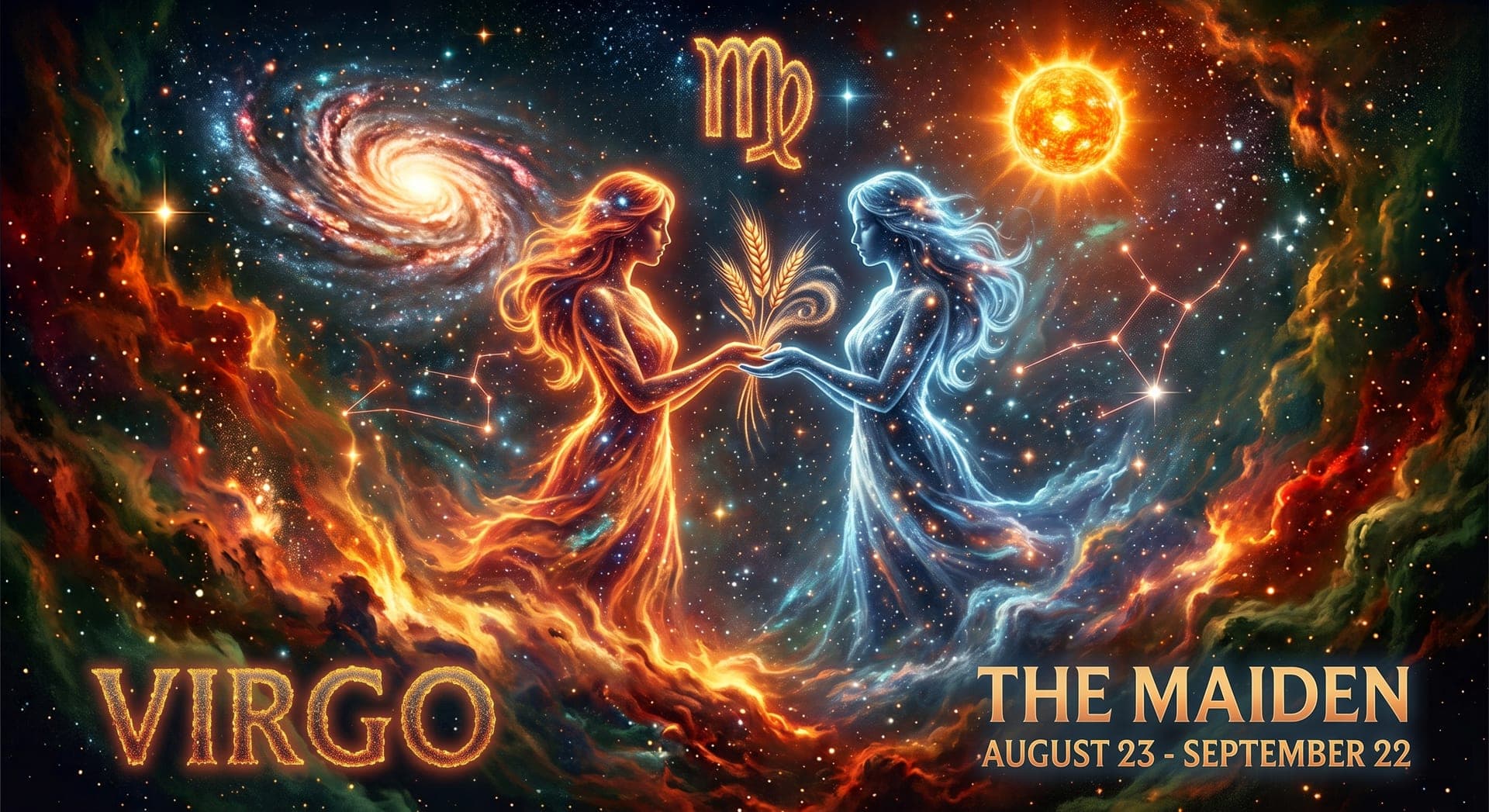
Virgo, the sixth sign of the zodiac, spans August 23 to September 22 and is symbolized by the maiden, often depicted holding a sheaf of wheat, representing purity, meticulous care, and the harvest. Ruled by Mercury, the planet of communication and intellect, Virgo channels its mental energy toward precision, analysis, and practical problem-solving rather than idle chatter. As an Earth sign, Virgo is grounded and detail-oriented, finding genuine satisfaction in organizing, refining, and perfecting the world around it. Its Mutable modality gives Virgo an adaptable, service-oriented nature, often finding purpose in quietly helping others and improving systems rather than seeking the spotlight. People born under this sign are frequently drawn to work requiring precision, research, or care for others, from science and medicine to editing and organization. Virgo's high standards make it an excellent problem-solver and a reliable presence others can count on, though that same perfectionism can turn inward as self-criticism or outward as an exacting, sometimes overly critical, eye toward the people and world around it.
Personality Traits
Strengths
- Highly organized and detail-oriented
- Reliable and hardworking
- Analytical problem-solver
- Genuinely helpful to others
- Modest and unpretentious
Weaknesses
- Prone to overcritical perfectionism
- Tends to worry excessively
- Can be overly critical of others
- Reserved to the point of aloofness
- Struggles to relax
Compatible Signs
Fun Facts
- Virgo's maiden symbol is often associated with Astraea, the Greek goddess of justice and purity, said to have been the last immortal to live among humans.
- Virgo is the only zodiac sign represented by a female human figure.
- Virgo and Gemini share Mercury as their ruling planet, though Virgo channels the planet's communicative energy toward analysis and precision rather than pure talkativeness.
- Notable Virgos include Beyoncé, Michael Jackson, Mother Teresa, and Stephen King.
- Virgo season falls at the tail end of summer, a period traditionally associated with harvest, meticulous preparation, and gathering resources for the colder months ahead.
Born on September 22
- 1791
Michael Faraday
English physicist and chemist whose discoveries in electromagnetism and electrochemistry underpin modern electrical technology
- 1880
Christabel Pankhurst
English suffragette leader who co-founded the Women's Social and Political Union
- 1885
Ben Chifley
16th Prime Minister of Australia
- 1895
Paul Muni
American actor
- 1927
Tommy Lasorda
American baseball manager
- 1931
Fay Weldon
English novelist and playwright known for satirical fiction including The Life and Loves of a She-Devil
- 1957
Nick Cave
Australian singer-songwriter
- 1958
Joan Jett
American rock singer and guitarist
- 1958
Andrea Bocelli
Italian tenor
- 1961
Liam Fox
Scottish physician and Conservative politician who served as Defence Secretary and Trade Secretary
- 1966
Ruth Jones
Welsh actress and screenwriter who co-created and starred in the sitcom Gavin & Stacey
- 1982
Billie Piper
English actress and singer known for playing companion Rose Tyler in Doctor Who
- 1987
Tom Felton
English actor best known for playing Draco Malfoy in the Harry Potter film series
On This Day in History
- 1236
Samogitian forces defeat the Livonian Brothers of the Sword at the Battle of Saule.
Pagan Samogitian warriors decisively defeated the crusading Livonian Brothers of the Sword at the Battle of Saule in present-day Lithuania, a defeat so severe that the surviving remnants of the military order were absorbed into the larger Teutonic Order shortly afterward. The battle marked a significant early setback for northern European Christian crusading efforts against Baltic pagan peoples.
- 1499
The Treaty of Basel concludes the Swabian War between the Swiss Confederacy and the Holy Roman Empire.
The Treaty of Basel formally concluded the Swabian War between the Swiss Confederacy and the Holy Roman Empire, a brief but decisive conflict sparked by disputes over territorial rights and tribute payments. The settlement effectively recognized Swiss independence from imperial authority in all but name, decades before formal international recognition of Swiss sovereignty followed at the end of the Thirty Years' War.
- 1586
Spanish forces fight their way past an English and Dutch ambush at the Battle of Zutphen.
Spanish troops resupplying the besieged garrison at Zutphen fought their way past an ambush laid by combined English and Dutch forces, a battle notable for the mortal wounding of English poet and soldier Sir Philip Sidney, who died from his injuries weeks later.
- 1586
A Spanish force fights past an English and Dutch ambush near Zutphen in the Netherlands, in a battle where the English poet-soldier Philip Sidney is mortally wounded.
The skirmish took place during the Anglo-Spanish War, as English troops sent to aid the Dutch revolt against Spanish rule clashed with a supply convoy near the besieged town. Sidney, shot in the thigh, reportedly gave his water to a dying soldier instead of drinking it himself, and the tale became one of the most celebrated legends of English chivalry.
- 1692
Eight people are hanged in Salem, Massachusetts, the last executions of the Salem witch trials.
The last eight people convicted in the notorious Salem witch trials were hanged, bringing to a close a period of hysteria that had resulted in the deaths of twenty people, a chapter in colonial American history now widely regarded as a profound miscarriage of justice.
- 1692
Eight people, including Martha Corey and Mary Eastey, are hanged in Salem, Massachusetts, in the final executions of the Salem witch trials.
The hangings brought the death toll of the witch trials to twenty, following months of hysteria fueled by spectral evidence and community rivalries in Puritan Massachusetts. Public opinion soon turned against the proceedings, and within a few years the colony formally repudiated the trials, apologizing to the accused and their families in one of early America's most notorious miscarriages of justice.
- 1761
George III and Charlotte of Mecklenburg-Strelitz are crowned King and Queen of Great Britain.
The young King George III and his new bride, Princess Charlotte of Mecklenburg-Strelitz, were formally crowned in a lavish coronation ceremony at Westminster Abbey, beginning a reign that would prove to be one of the longest in British history to that point.
- 1761
George III and his new wife Charlotte of Mecklenburg-Strelitz are crowned King and Queen of Great Britain at Westminster Abbey.
The coronation came just weeks after the couple's wedding and marked the formal start of a reign that would last nearly 60 years, the longest of any British king to that point. George III's rule spanned the loss of the American colonies, the Napoleonic Wars, and the early Industrial Revolution, before ending in his final years of illness and mental decline.
- 1776
American revolutionary Nathan Hale is executed by British forces for espionage.
Convicted of espionage after volunteering to gather intelligence behind British lines in New York, the young American soldier Nathan Hale was executed by hanging without a formal trial, reportedly declaring his regret at having only one life to give for his country. His words, though possibly embellished by later retellings, made him a celebrated martyr of the American Revolution.
- 1862
Abraham Lincoln issues the preliminary Emancipation Proclamation.
President Abraham Lincoln issued a preliminary version of the Emancipation Proclamation following the Union's tactical victory at Antietam, warning that he would formally free enslaved people in Confederate-held territory if the rebellion did not end by the start of the new year.
- 1862
President Abraham Lincoln issues the Preliminary Emancipation Proclamation, announcing that slaves in Confederate territory will be declared free from the start of 1863.
Lincoln had been waiting for a Union military success to announce the proclamation, which came days after the Battle of Antietam halted a Confederate invasion of the North. The announcement transformed the Civil War's purpose into a fight against slavery as well as for the Union, and discouraged Britain and France, both of which had abolished slavery, from recognizing the Confederacy.
- 1885
Lord Randolph Churchill delivers a speech opposing Irish Home Rule, helping to galvanize Conservative and Unionist opposition to Irish self-government.
The Conservative politician, father of Winston Churchill, was a leading voice against William Gladstone's plans to grant Ireland a devolved parliament, warning that Home Rule would weaken the Union and threaten Protestant Ulster. His campaigning helped forge the lasting alliance between the Conservative Party and Ulster Unionism that shaped British and Irish politics for generations.
- 1896
Queen Victoria becomes the longest-reigning British monarch to that point, surpassing King George III.
Queen Victoria surpassed her grandfather King George III's tenure to become the longest-reigning monarch in British history to that date, a remarkable milestone during a reign that had already witnessed enormous industrial, social, and imperial transformation. Rather than a public celebration, Victoria, still in mourning for her husband Prince Albert decades earlier, marked the occasion privately and modestly.
- 1896
Queen Victoria surpasses King George III to become the longest-reigning monarch in British history at that time.
Victoria had ascended the throne in 1837 following the death of her uncle William IV, and by this date had reigned for over 59 years, longer than any previous British sovereign. Her long reign, marked by industrial growth and imperial expansion, gave its name to the Victorian era and extended for nearly five more years until her death in 1901.
- 1910
The Duke of York's Picture House opens in Brighton, England, and remains today the oldest continually operating cinema in the country.
Purpose-built for the exhibition of moving pictures at a time when cinema was still a novelty, the Brighton venue survived changing fashions, wartime disruption, and the rise of multiplexes to keep screening films into the 21st century. Its continued operation makes it a rare surviving link to the earliest days of British cinema-going.
- 1914
A single German submarine, U-9, sinks three Royal Navy armored cruisers in the North Sea, killing nearly 1,500 British sailors.
HMS Aboukir, Cressy, and Hogue were sunk within about an hour after the Aboukir was torpedoed and the other two ships stopped to rescue survivors, making themselves easy targets. The disaster, one of the deadliest single actions for the Royal Navy in the war's early months, exposed the vulnerability of aging warships to submarine attack and forced a rethink of naval tactics.
- 1934
An underground explosion at the Gresford colliery near Wrexham, Wales, kills 266 miners and rescuers in one of Britain's worst mining disasters.
A gas explosion deep underground triggered a fire that made much of the mine impossible to safely reach, so most of the dead were never recovered and the affected section was later sealed and abandoned. The tragedy prompted a public inquiry into safety practices and became a defining symbol of the dangers faced by Welsh coal miners, commemorated in the song 'The Gresford Disaster'.
- 1939
German and Soviet forces hold a joint military parade in Brest-Litovsk following the invasion of Poland.
German and Soviet military forces held a joint victory parade in the Polish city of Brest-Litovsk following their coordinated invasion and partition of Poland, a striking public display of cooperation between the two totalitarian powers before their alliance later collapsed into war.
- 1980
Iraq invades Iran, sparking the eight-year Iran-Iraq War.
Iraqi forces under Saddam Hussein launched a surprise invasion of neighboring Iran, seeking to exploit the chaos following Iran's Islamic Revolution and settle longstanding border and territorial disputes. The resulting eight-year war produced enormous casualties on both sides, including extensive use of chemical weapons, without ultimately producing a decisive military outcome or significant border changes.
- 1980
Iraq launches a full-scale invasion of Iran, beginning the eight-year Iran–Iraq War.
Saddam Hussein ordered the attack hoping to exploit the chaos of Iran's recent revolution and seize disputed border territory, including control of the Shatt al-Arab waterway. The war that followed became one of the longest and bloodiest conflicts of the 20th century, marked by trench warfare and chemical weapons attacks, before ending in a stalemate in 1988.