What’s Observed on October 1
Born on October 1: Libra ♎
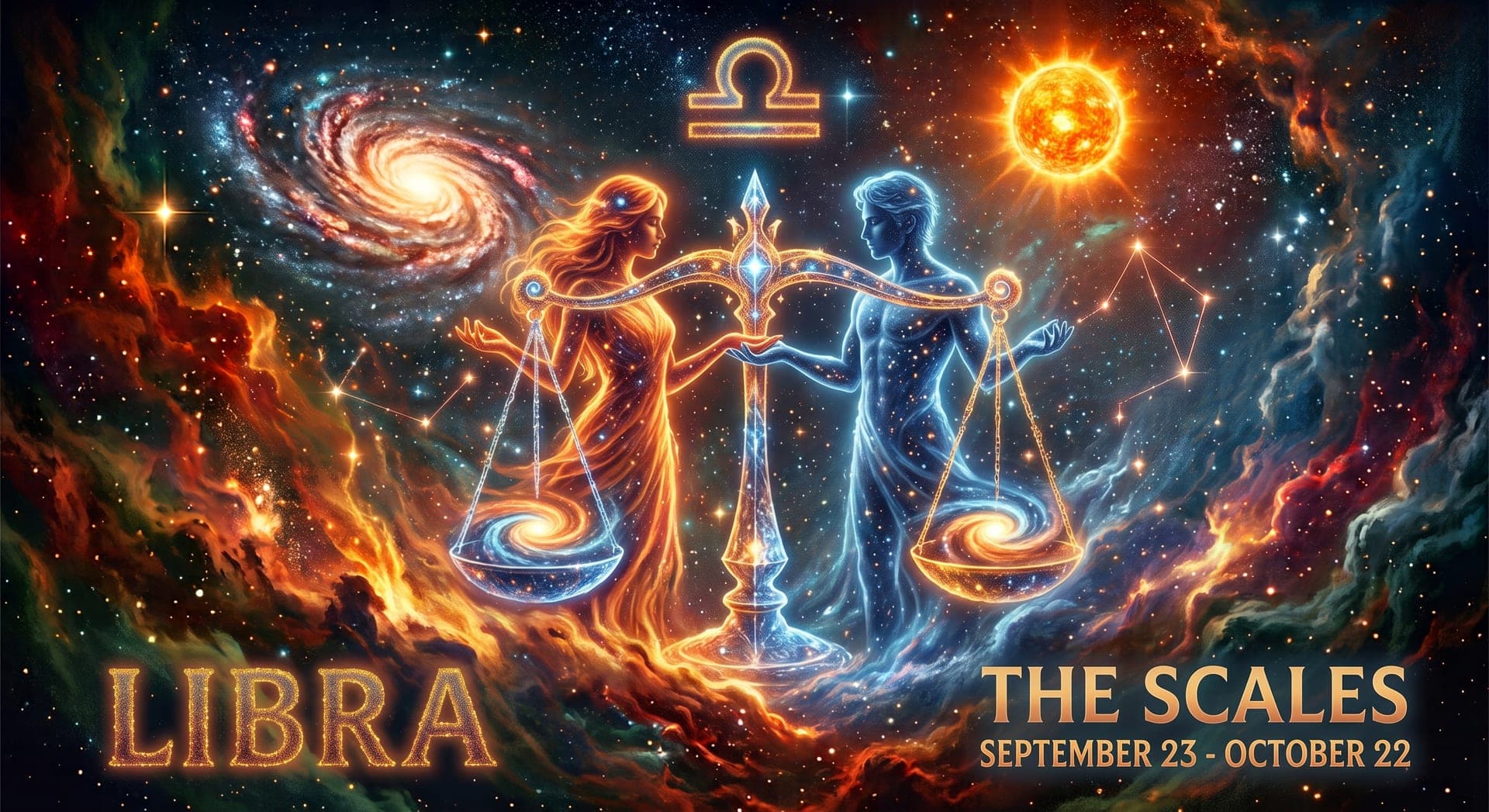
Libra, the seventh sign of the zodiac, spans September 23 to October 22 and is symbolized by the scales, the only zodiac symbol representing an inanimate object rather than a living creature, reflecting the sign's deep concern with balance, fairness, and justice. Ruled by Venus, the planet of love and beauty, Libra shares Taurus's appreciation for aesthetics and pleasure but channels it primarily through relationships, partnership, and social harmony. As an Air sign, Libra approaches the world intellectually and socially, valuing thoughtful conversation and diplomatic problem-solving over confrontation. Its Cardinal modality places it at the very start of autumn, beginning right at the equinox when day and night briefly achieve perfect balance. People born under this sign are often natural mediators, drawn to fairness and equilibrium in their relationships and surroundings, sometimes to the point of struggling to make decisions that might upset that balance. Libra's charm, diplomacy, and genuine desire to see all sides of an issue make it a valued friend and partner, even as its conflict-avoidance can occasionally leave real problems unresolved.
Personality Traits
Strengths
- Strong sense of fairness and justice
- Diplomatic peacemaker
- Charming and sociable
- Appreciates beauty and harmony
- Excellent at seeing multiple perspectives
Weaknesses
- Notoriously indecisive
- Conflict-avoidant to a fault
- Can be superficial
- People-pleasing tendencies
- Struggles with confrontation
Compatible Signs
Fun Facts
- Libra is the only zodiac sign represented by an inanimate object, the scales, rather than an animal or person.
- Libra's scales symbolize balance and justice, echoing the sign's association with fairness, harmony, and diplomacy.
- Venus, Libra's ruling planet, gives the sign its love of beauty, art, and romantic partnership, similar to Taurus but expressed through relationships rather than material comfort.
- As a Cardinal sign, Libra initiates autumn, beginning at the September equinox, when day and night are of equal length, fitting for a sign obsessed with balance.
- Notable Libras include Mahatma Gandhi, Kim Kardashian, John Lennon, and Will Smith.
Born on October 1
- 1207
Henry III of England
King of England for 56 years, whose long and turbulent reign saw the drafting of the Provisions of Oxford and the rebuilding of Westminster Abbey in its present Gothic form.
- 1847
Annie Besant
English-born social reformer, theosophist and women's rights campaigner who later became a leading figure in the Indian independence movement.
- 1881
William Boeing
American businessman who founded the Boeing Company
- 1890
Stanley Holloway
English actor and singer best known for his comic monologues and for playing Alfred Doolittle in the stage and film versions of My Fair Lady.
- 1903
Vladimir Horowitz
Russian-American concert pianist
- 1912
Kathleen Ollerenshaw
English mathematician and politician who served as Lord Mayor of Manchester and made notable contributions to the mathematics of magic squares.
- 1924
Jimmy Carter
39th President of the United States and Nobel Peace Prize laureate
- 1935
Julie Andrews
English actress and singer celebrated for iconic film roles in Mary Poppins and The Sound of Music.
- 1936
Duncan Edwards
English footballer for Manchester United and one of the "Busby Babes," who died at 21 from injuries sustained in the 1958 Munich air disaster.
- 1956
Theresa May
British Conservative politician who served as Prime Minister of the United Kingdom from 2016 to 2019, overseeing the early stages of Brexit negotiations.
- 1959
Youssou N'Dour
Senegalese singer-songwriter and musician
- 1963
Mark McGwire
American Major League Baseball player
- 1964
Harry Hill
English comedian and television presenter known for his surreal humour and long-running show Harry Hill's TV Burp.
- 1966
George Weah
Liberian footballer and President of Liberia
On This Day in History
- 331 BCE
Alexander the Great decisively defeats Darius III of Persia at the Battle of Gaugamela, effectively ending the Achaemenid Empire.
Alexander's outnumbered but highly disciplined Macedonian army faced Darius III's much larger Persian force on a plain near modern-day Iraq, where superior tactics and cavalry maneuvering overcame the numerical disadvantage. Darius fled the battlefield before the fighting concluded, and his subsequent assassination by his own subordinates left Alexander as effective master of the vast Persian Empire, opening the way for his rule over territory stretching from Greece to India.
- 959
Edgar the Peaceful became king of all England upon the death of his brother, King Eadwig.
Edgar's accession united Wessex, Mercia and Northumbria under a single crown for the first time in a sustained way, following years of divided rule between the two brothers. His sixteen-year reign, supported closely by the reformer Dunstan, is remembered as a golden age of Anglo-Saxon monarchy marked by monastic reform and consolidated royal authority.
- 1553
Queen Mary I of England is crowned at Westminster Abbey.
Mary became England's first queen to rule in her own right, having secured the throne after the brief, contested reign of Lady Jane Grey following the death of her half-brother Edward VI. Her coronation marked the restoration of Catholicism as England's official religion after her father Henry VIII's break from Rome, a reversal that led to her later reputation as "Bloody Mary" for the persecution of Protestants during her reign.
- 1553
Mary I was crowned Queen of England at Westminster Abbey.
Mary became the first woman to be crowned monarch of England in her own right, having secured the throne after defeating the attempt to install Lady Jane Grey as queen. Her coronation confirmed the Tudor succession and preceded her efforts to restore Catholicism in England, a campaign that led to religious persecution during her five-year reign.
- 1814
European leaders convene at the Congress of Vienna to reshape the continent following Napoleon's defeat.
Following Napoleon's first defeat and exile to Elba, representatives of the major European powers gathered in Vienna to redraw the continent's political map and restore a balance of power intended to prevent future large-scale European conflict. The resulting settlement, though interrupted by Napoleon's brief return during the Hundred Days, established a diplomatic framework that helped maintain relative stability among Europe's major powers for decades afterward.
- 1861
Isabella Beeton's Book of Household Management was published in London.
Compiled by 25-year-old Isabella Beeton and issued through her husband's publishing firm, the book combined recipes, etiquette and domestic advice into one of the best-selling household guides of the Victorian era. It shaped British domestic life for generations and made "Mrs Beeton" a household name synonymous with respectable Victorian homemaking.
- 1887
British forces completed the conquest of Balochistan, bringing the region to the borders of Afghanistan under British Indian control.
The annexation extended the strategically vital region bordering Afghanistan and Persia into British India as part of the broader "Great Game" contest with Russia for influence in Central Asia. Balochistan subsequently became a province of British India and, after 1947, of Pakistan.
- 1890
The United States Congress establishes Yosemite National Park.
Responding to growing concerns about unchecked logging and development threatening the Sierra Nevada's dramatic granite cliffs and ancient sequoia groves, Congress designated Yosemite as a protected national park, building on an earlier 1864 grant that had placed the valley under California state protection. The park later became closely associated with conservationist John Muir, whose advocacy helped shape the broader American national park movement.
- 1891
Stanford University welcomes its first students in California.
Founded by railroad magnate Leland Stanford and his wife Jane in memory of their only child, who died young, Stanford University opened with a relatively small class of pioneering students on a vast former horse farm in California. The university grew over the following century into one of the world's most prestigious research institutions, later playing a foundational role in the development of Silicon Valley's technology industry.
- 1923
The 1923 Imperial Conference opened in London, bringing together leaders of the British Empire's self-governing dominions.
Delegates from Britain, Canada, Australia, South Africa, New Zealand and other dominions met to discuss foreign policy, trade and the evolving constitutional relationship between Britain and its dominions. The conference was a step toward the greater dominion autonomy later formalised in the 1926 Balfour Declaration and the 1931 Statute of Westminster.
- 1942
The American submarine USS Grouper torpedoed the Japanese transport ship Lisbon Maru, unaware it was carrying more than 1,800 British prisoners of war.
The Lisbon Maru was transporting British servicemen captured at the fall of Hong Kong, and its Japanese guards battened down the hatches as the ship sank off the Chinese coast, drowning hundreds of the trapped POWs. Chinese fishermen rescued many survivors at great personal risk, and the disaster remains one of the deadliest losses of British captives during the Pacific War.
- 1949
The People's Republic of China is officially established under Mao Zedong.
Mao Zedong proclaimed the founding of the People's Republic of China from atop Tiananmen Gate in Beijing, marking the Chinese Communist Party's victory in the long civil war against Nationalist forces, who subsequently retreated to Taiwan. The declaration launched a dramatic political and social transformation of China under Communist rule that continues to shape the nation and global geopolitics today.
- 1960
Nigeria gains independence from the United Kingdom.
Nigeria achieved independence from British colonial rule, becoming Africa's most populous nation with a federal government structure intended to balance power among its diverse ethnic and religious populations. The transition, initially celebrated as a hopeful new chapter, was soon followed by significant political instability, including a civil war within the decade, reflecting the immense challenges of nation-building across colonially drawn borders.
- 1960
Nigeria gained independence from the United Kingdom, becoming a sovereign nation within the Commonwealth.
Nigeria's independence ended six decades of British colonial rule and created Africa's most populous nation, with Sir Abubakar Tafawa Balewa as its first prime minister. The transition was largely peaceful, though it left in place regional and ethnic tensions that later contributed to civil war.
- 1969
The British-French Concorde supersonic airliner broke the sound barrier for the first time during a test flight.
Developed jointly by the British Aircraft Corporation and France's Aerospatiale, Concorde was a flagship achievement of Anglo-French aerospace engineering during the Cold War jet age. The milestone flight, six months after Concorde's maiden flight, marked a key step toward commercial supersonic passenger service, which began in 1976.
- 1971
Walt Disney World opens near Orlando, Florida.
Walt Disney World opened in central Florida as a vastly expanded successor to California's original Disneyland, built on tens of thousands of acres of previously undeveloped land purchased secretly to avoid inflated prices. The resort grew into the world's most visited vacation destination, fundamentally transforming the Orlando region's economy and establishing Disney as a dominant force in global tourism and entertainment.
- 1978
Tuvalu gained independence from the United Kingdom, becoming a separate Commonwealth realm.
Formerly part of the Gilbert and Ellice Islands colony, Tuvalu split from the Gilbert Islands, which became Kiribati, following a 1974 referendum, and achieved full independence with Elizabeth II remaining head of state. It became one of the world's smallest and most climate-vulnerable sovereign nations.
- 1982
Sony releases the first commercial compact disc player, the CDP-101.
Sony's CDP-101 became the first commercially available compact disc player, launched alongside the compact disc format itself as a joint venture between Sony and Philips intended to replace vinyl records and cassette tapes with a more durable, higher-fidelity digital format. The technology transformed the music industry over the following decade, eventually itself being displaced by digital downloads and streaming.
- 2009
The Supreme Court of the United Kingdom formally began operating, taking over the judicial functions previously held by the House of Lords.
Established under the Constitutional Reform Act 2005, the new Supreme Court separated the judiciary's highest court from the legislature for the first time, ending the historic role of the Law Lords. The change was intended to reinforce the separation of powers within the UK's constitutional framework.
- 2017
A Catalonian independence referendum takes place, later declared illegal by Spain's Constitutional Court.
Catalan regional authorities held a referendum on independence from Spain despite the Spanish government declaring the vote illegal and deploying police to forcibly disrupt polling stations, resulting in violent clashes and international condemnation. The disputed vote and its chaotic aftermath, including a subsequent unilateral declaration of independence, triggered Spain's most significant constitutional crisis in decades.